


Page 129 - Calculus Workbook For Dummies
P. 129
113
                                             Chapter 7: Analyzing Those Shapely Curves with the Derivative


                                                      1  6
                                                    4
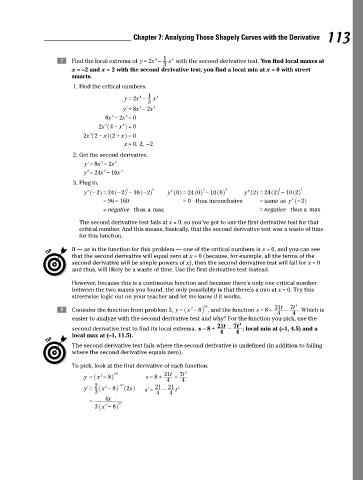
                    g Find the local extrema of  y =  2 x -  x with the second derivative test. You find local maxes at
                                                      3
                         x = –2 and x = 2 with the second derivative test; you find a local min at x = 0 with street
                         smarts.
                         1. Find the critical numbers.
                                                 1  6
                                               4
                                          y =  2 x -  x
                                                 3
                                               3
                                         y = l  8 x -  2 x  5
                                          5
                                      3
                                   8 x -  2 x =  0
                                         2
                                   3
                                 2 x 4 -  x i  =  0
                                    _
                              3
                                         x =
                                     ^
                            2 ^    x 2 + h  0
                             x 2 - h
                                          x =  0 , , 2 - 2
                         2. Get the second derivative.
                                  3
                             y = l  8 x -  2 x  5
                                   2
                              m
                            y =  24 x -  10 x  4
                         3. Plug in.
                                          2        4               2       4                2      4
                                 2 =
                                         2 -
                                                                                          ^ h
                                                                 ^ h
                                                                                  m ^ h
                                                         m ^ h
                              m ^
                            y - h   24 - h   10 - 2h    y 0 =  24 0 -  10 0 ^ h  y 2 =  24 2 -  10 2 ^ h
                                               ^
                                       ^
                                   =  96 -  160              =  0  thus inconclusive  =  same as y - 2h
                                                                                                m ^
                                   =  negative  thus a  max                           =  negative thus a max
                           The second derivative test fails at x = 0, so you’ve got to use the first derivative test for that
                           critical number. And this means, basically, that the second derivative test was a waste of time
                           for this function.
                         If — as in the function for this problem — one of the critical numbers is x = 0, and you can see
                         that the second derivative will equal zero at x = 0 (because, for example, all the terms of the
                         second derivative will be simple powers of x), then the second derivative test will fail for x = 0
                         and thus, will likely be a waste of time. Use the first derivative test instead.
                         However, because this is a continuous function and because there’s only one critical number
                         between the two maxes you found, the only possibility is that there’s a min at x = 0. Try this
                         streetwise logic out on your teacher and let me know if it works.
                                                                    / 2 3                  21 t  t 7  3
                                                               2
                                                                                        8
                    h Consider the function from problem 3,  y = _ x -  8i , and the function s = +  -  . Which is
                                                                                            4    4
                         easier to analyze with the second derivative test and why? For the function you pick, use the
                                                                        21 t  t 7  3
                         second derivative test to find its local extrema. s =  8 +  4  -  4  ; local min at (–1, 4.5) and a
                         local max at (–1, 11.5).
                         The second derivative test fails where the second derivative is undefined (in addition to failing
                         where the second derivative equals zero).
                         To pick, look at the first derivative of each function:
                                       / 2 3           21 t  t 7  3
                                  2
                                                   8
                            y = _ x -  8i        s = +    -
                                                       4    4
                                2  2    -  / 1 3    21  21
                            y = l  _ x -  8i  2 ^  xh  s = l  -  t  2
                                3                   4   4
                                   4 x
                              =         / 1 3
                                   2
                                3 _ x -  8i

