


Page 130 - Calculus Workbook For Dummies
P. 130
114       Part III: Differentiation


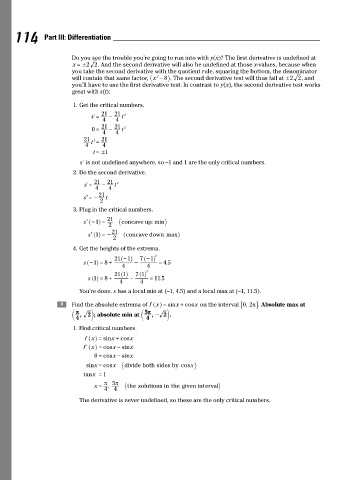
                         Do you see the trouble you’re going to run into with y(x)? The first derivative is undefined at
                         x =  ! 2 2. And the second derivative will also be undefined at those x-values, because when
                         you take the second derivative with the quotient rule, squaring the bottom, the denominator
                                                    2
                         will contain that same factor,  x -  8i. The second derivative test will thus fail at  2 2!  , and
                                                  _
                         you’ll have to use the first derivative test. In contrast to y(x), the second derivative test works
                         great with s(t):
                         1. Get the critical numbers.
                                  21  21  2
                               s = l  -  t
                                   4   4
                                  21  21  2
                               0 =   -   t
                                   4   4
                            21  t =  21
                                2
                             4     4
                               t =  ! 1
                           sl is not undefined anywhere, so –1 and 1 are the only critical numbers.
                         2. Do the second derivative.
                                21  21
                             s = l  -  t  2
                                4   4
                                 21
                             m
                            s = -   t
                                  2
                         3. Plug in the critical numbers.
                                    21
                                1 =
                             m ^
                            s - h       _ concave up : mini
                                    2
                                      21
                              s 1 = -    ^ concave down : maxh
                               m ^ h
                                      2
                         4. Get the heights of the extrema.
                                                    3
                                      21 - 1h  7 - 1h
                                                ^
                                        ^
                                1 = +
                             ^
                            s - h  8         -       =  . 4 5
                                         4       4
                                                 3
                                      21 1 ^ h  7 1 ^ h
                                   8
                              s 1 = +       -     =  11 .5
                               ^ h
                                        4      4
                           You’re done. s has a local min at (–1, 4.5) and a local max at (–1, 11.5).
                                                                                   2
                    i Find the absolute extrema of f x =  sinx +  cosx on the interval  , πA. Absolute max at
                                                   ^ h
                                                                                0 7
                          π                     5 π
                         c  ,  2m; absolute min at c  , -  2m.
                          4                      4
                         1. Find critical numbers.
                             f x =  sinx +  cosx
                              ^ h
                               x =
                            f l ^ h  cosx -  sinx
                                0 =  cosx -  sinx
                             sinx =  cosx _ divide both sides by  cosxi
                            tanx =  1
                                   π 5 π
                                x =  ,    _ the solutions in the given  intervali
                                   4  4
                           The derivative is never undefined, so these are the only critical numbers.

