


Page 128 - Calculus Workbook For Dummies
P. 128
112       Part III: Differentiation


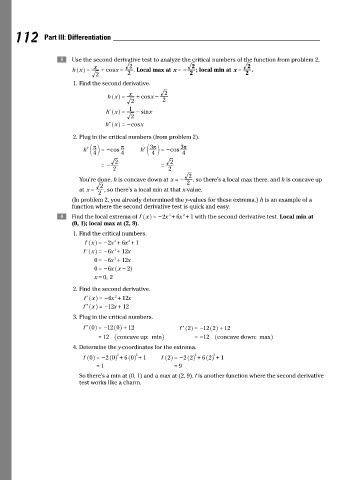
                    e Use the second derivative test to analyze the critical numbers of the function from problem 2,
                                x          2                    2                 2
                         h x =    +  cosx -  . Local max at x = -  ; local min at x =  .
                          ^ h
                                2          2                   2                 2
                         1. Find the second derivative.
                                           x           2
                                    h x =     +  cosx -
                                     ^ h
                                            2         2
                                           1
                                    h x =     -  sinx
                                     l ^ h
                                            2
                                   h x = -  cosx
                                     m ^ h
                         2. Plug in the critical numbers (from problem 2).
                               π         π        3 π       3 π
                            hm c m  = - cos    hm c  m  = - cos
                               4         4         4         4
                                       2                 2
                                  = -                 =
                                      2                 2
                                                               2
                           You’re done. h is concave down at x = -  2  , so there’s a local max there, and h is concave up
                                  2
                           at x =  , so there’s a local min at that x-value.
                                 2
                         (In problem 2, you already determined the y-values for these extrema.) h is an example of a
                         function where the second derivative test is quick and easy.
                                                             2
                                                        3
                                                               1
                    f Find the local extrema of f x = - 2 x +  6 x + with the second derivative test. Local min at
                                                ^ h
                         (0, 1); local max at (2, 9).
                         1. Find the critical numbers.
                                           2
                                      3
                             f x = - 2 x +  6 x +  1
                              ^ h
                                      2
                            f l ^ h  6 x +  12 x
                               x = -
                                      2
                                0 = - 6 x +  12 x
                                     x x -
                                0 = - 6 ^  2h
                                x =  , 0 2
                         2. Find the second derivative.
                                       2
                               x = -
                            f l ^ h  6 x +  12 x
                               x = -
                            f m ^ h  12 x +  12
                         3. Plug in the critical numbers.
                               0 = -
                            f m ^ h  12 0 +  12             f m ^ h  12 2 +  12
                                                              2 = -
                                      ^ h
                                                                      ^ h
                                 =  12 _ concave up : mini       = - 12 ^ concave down: maxh
                         4. Determine the y-coordinates for the extrema.
                                       3     2                   3     2
                                                       ^
                             ^
                            f 0 = - ^h  2 0 + ^h  6 0 +  1  f 2 = - ^h  2 2 + ^h  6 2 +  1
                                                                      h
                                             h
                                 =  1                     =  9
                           So there’s a min at (0, 1) and a max at (2, 9). f is another function where the second derivative
                           test works like a charm.

