


Page 133 - Calculus Workbook For Dummies
P. 133
117
                                             Chapter 7: Analyzing Those Shapely Curves with the Derivative


                                      - π
                         Technically x =  is not one of the critical numbers; being at an endpoint, it is refused mem-
                                       2
                         bership in the critical number club. It’s a moot point though, because you have to evaluate the
                         endpoints anyway.

                                       π           π       π
                                               c
                                    q c m  =  2 cos 2 $  m  +  4 sin
                                       6           6       6
                                              1    1
                                          =  2 $  +  4 $  =  3
                                              2    2
                                       π           π       π
                                               c
                                    q c m  =  2 cos 2 $  m  +  4 sin
                                       2           2       2
                                                4
                                          = - 2 + =  2
                                      5 π          5 π      5 π
                                   q c  m  =  2 cos 2 $  m  +  4 sin
                                               c
                                      6            6         6
                                              1    1
                                          =  2 $  +  4 $  =  3
                                              2    2
                                         π             π         π
                         Left endpoint: q -  m  =  2  cos 2 - $  m  +  4  sin -  m  = - 2 + ^  1 = - 6
                                                                          4 - h
                                                               c
                                       c
                                                  c
                                         2             2         2
                                                                          J    N
                                         5 π          5 π      5 π            2 O
                                                                   2 0 + K
                                                  c
                                                                          K
                         Right endpoint: q c  m  =  2  cos 2 $  m  +  4  sin  = $  4 -  . -  . 2 828
                                          4           4         4            2 O
                                                                          L    P
                                                                      π                              π
                         Pick your winners: Absolute min at left endpoint:  -  , - 6m and a tie for absolute max: c  , 3m
                                                                   c
                                                                      2                              6
                             5 π
                         and c  , 3m.
                              6
                                                                                     3
                                                                                          2
                    m Find the intervals of concavity and the inflection points of f x = - 2 x +  6 x -  10 x +  5. f is con-
                                                                            ^ h
                                     -
                         cave up from  3 to the inflection point at (1, –1), then concave down from there to 3.
                         1. Get the second derivative.
                                       3
                                           2
                             f x = - 2 x +  6 x -  10 x +  5
                              ^ h
                                       2
                               x = -
                            f l ^ h  6 x +  12 x -  10
                               x = -
                            f m ^ h  12 x +  12
                         2. Set equal to 0 and solve.
                            - 12 x +  12 0
                                     =
                                   x =  1
                         3. Check for x-values where the second derivative is undefined. None.
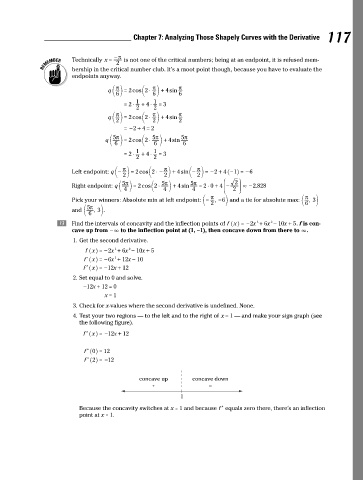
                         4. Test your two regions — to the left and to the right of x = — and make your sign graph (see
                                                                            1
                           the following figure).
                               x = -
                            f m ^ h  12 x +  12
                               0 =
                             f m ^ h  12
                               2 = -
                             f m ^ h  12
                                              concave up        concave down
                                                   +                 –
                                                            1
                           Because the concavity switches at x = 1 and because f m equals zero there, there’s an inflection
                           point at x = 1.

