


Page 134 - Calculus Workbook For Dummies
P. 134
118       Part III: Differentiation


                         5. Find the height of the inflection point.

                                      3
                                           2
                            f x = - 2 x +  6 x -  10 x +  5
                             ^ h
                             f 1 = - 1
                              ^ h
                           Thus f is concave up from  3-  to the inflection point at (1, –1), then concave down from there
                           to 3. As always, you should check your result on your graphing calculator. Hint: To get a good
                           feel for the look of this function, you’ll need a fairly odd graphing window — try something
                           like xmin = –2, xmax = 4, ymin = –20, ymax = 20.
                                                                                        2
                                                                                   4
                    n Find the intervals of concavity and the inflection points of g x =  x -  12 x . g is concave up
                                                                             ^ h
                         from  3-  to the inflection point at  -  , 2 - 20j; then concave down to an inflection point at
                                                       `
                         `  , 2 - 20j; then concave up again to 3.
                         1. Find the second derivative.
                                    4
                             g x =  x -  12 x  2
                              ^ h
                                     3
                             g x =  4 x -  24 x
                              l ^ h
                                      2
                               x =
                            gm ^ h  12 x -  24
                         2. Set to 0 and solve.
                               2
                                    =
                            12 x -  24 0
                                   2
                                  x =  2
                                   x =  !  2
                         3. Is the second derivative undefined anywhere? No.
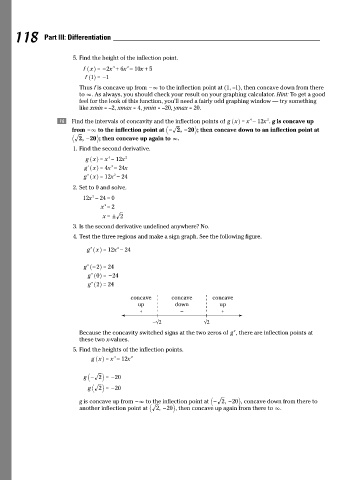
                         4. Test the three regions and make a sign graph. See the following figure.
                                       2
                                x =
                             gm ^ h  12 x -  24
                                 2 =
                            gm ^ - h  24
                                 0 = -
                              gm ^ h  24
                                 2 =
                              gm ^ h  24
                                            concave      concave      concave
                                              up          down           up
                                               +            –            +


                           Because the concavity switched signs at the two zeros of gm, there are inflection points at
                           these two x-values.
                         5. Find the heights of the inflection points.
                                      4
                               g x =  x -  12 x  2
                                ^ h
                            g -  2 = - 20
                                  j
                              `
                              g `  2 = - 20
                                  j
                           g is concave up from  3-  to the inflection point at  -  , 2 - 20j, concave down from there to
                                                                      `
                           another inflection point at `  , 2 - 20j, then concave up again from there to 3.

