


Page 127 - Calculus Workbook For Dummies
P. 127
111
                                             Chapter 7: Analyzing Those Shapely Curves with the Derivative


                                                                                  4
                                                                                 t +  4
                    d Using the first derivative test, determine the local extrema of s =  2 . Local maxes at
                                                                                 -  t 2
                         ` -  , 2 - 2j and `  , 2 - 2j.
                         1. Do the differentiation thing.
                                4
                                t +  4
                             s =   2
                                -  t 2
                                                       2 l
                                                                         4
                                          2
                                                                    2
                                                              3
                                 4
                                               4
                                                                           4 -
                                                  4 -
                                _ t +  4 _i l  -  t 2 i  - _ t + i _  t 2 i  _  t 4 i _ -  t 2 i  - _ t + i ^  t 4 h  t - +  4
                                                                                      4
                            s = l              2          =            4          =    3
                                             2
                                         _ -  t 2 i                    t 4            t
                         2. Find the critical numbers.
                                            4
                                           t - +  4  =  0
                                            t  3
                                                4
                                            4 -  t =  0
                                        2
                                               2
                                    _ 2 -  t _ i  2 +  t i  =  0
                                               2
                            `  2 -  t `j  2 +  t _ j  2 +  t i  =  0
                                               t =  2 or -  2
                           So -  2 and  2 are two critical numbers of s.
                         t = 0 is a third important number because t = 0 makes the derivative’s denominator equal zero,
                         and so you need to include zero on your sign graph in order to define test regions. Note, how-
                         ever, that t = 0 is not a critical number of s because s is undefined at t = 0. And because there is
                         no point on s at t = 0, there cannot be a local extremum at t = 0.
                         3. Test values: You’re on your own.
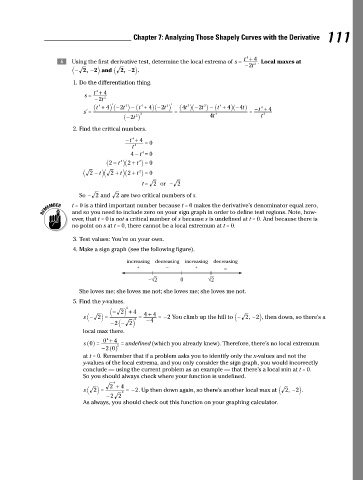
                         4. Make a sign graph (see the following figure).
                                          increasing  decreasing  increasing  decreasing
                                              +        –         +        _
                                                            0
                           She loves me; she loves me not; she loves me; she loves me not.
                         5. Find the y-values.
                                          4
                                          j
                                     ` -  2 +  4
                            s -  2 =         2 =  4 +  4  = - 2 You climb up the hill to  -  , 2 - 2j, then down, so there’s a
                                                                              `
                                  j
                             `
                                      2 -
                                     - `   2j    - 4
                            local max there.
                                    4
                                   0 +  4
                            s 0 =      2 =  undefined (which you already knew). Therefore, there’s no local extremum
                             ^ h
                                  - 2 0 ^ h
                            at t = 0. Remember that if a problem asks you to identify only the x-values and not the
                            y-values of the local extrema, and you only consider the sign graph, you would incorrectly
                            conclude — using the current problem as an example — that there’s a local min at t = 0.
                            So you should always check where your function is undefined.
                                      4
                                     2 +  4
                                 j
                            s `  2 =     2 = - 2. Up then down again, so there’s another local max at `  , 2 - 2j.
                                    - 2 2
                            As always, you should check out this function on your graphing calculator.

