


Page 157 - Calculus Workbook For Dummies
P. 157
141
                                                    Chapter 8: Using Differentiation to Solve Your Problems


                                                                                              25
                           That’s about 15 ounces. The can will be 2 1 $  .63 or about 3 ⁄4 inches wide and   -  . 1 63 or
                                                                            1
                                                                                            π $  . 1 63
                           about 3 ⁄4 inches tall. Isn’t that nice? The largest can has the same width and height and would
                                 1
                           thus fit perfectly into a cube. Geometric optimization problems frequently have results where
                           the dimensions have some nice, simple mathematical relation to each other.
                    b . . . What dimensions will minimize the cost of the frame? The dimensions are 4’3’’ wide and
                         5’1’’ high. The minimum cost is $373.
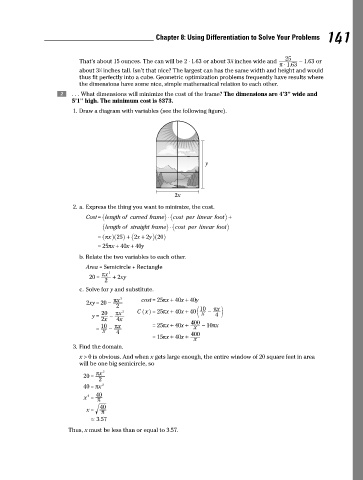
                         1. Draw a diagram with variables (see the following figure).


                                                                    y


                                                          2x

                         2. a. Express the thing you want to minimize, the cost.
                             Cost = _ length of curved frame $ _ cost per linear foot +
                                                                          i
                                                       i
                                                       i
                                   _ length of straight frame $ _ cost per linear footi
                                    x 25 + _
                                 = ^ π h ^  h  2 x +  y 2 ^ i  20h
                                 =  25 π x +  40 x +  40 y
                           b. Relate the two variables to each other.
                             Area = Semicircle + Rectangle
                                  π x  2
                              20 =    +  2 xy
                                   2
                           c. Solve for y and substitute.
                                      π x  2   cost 25 π x +  40 x +  40 y
                                                   =
                             2 xy 20 -
                                =
                                       2                          10   π x
                                               ^ h
                                  20   π x  2  C x =  25 π x +  40 x +  40 c  x  -  m
                               y =   -                                 4
                                  2 x  4 x
                                  10  π x          =  25 π x +  40 x +  400  -  10 π x
                                =    -                          x
                                   x   4                       400
                                                   =  15 π x +  40 x +  x
                         3. Find the domain.
                           x > 0 is obvious. And when x gets large enough, the entire window of 20 square feet in area
                           will be one big semicircle, so
                                π x  2
                            20 =
                                 2
                            40 =  π x  2
                                40
                              2
                            x =  π
                                  40
                             x =  π
                               .  . 3 57
                       Thus, x must be less than or equal to 3.57.

