


Page 160 - Calculus Workbook For Dummies
P. 160
144       Part III: Differentiation


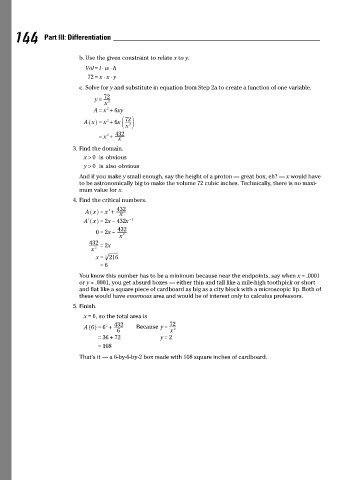
                           b. Use the given constraint to relate x to y.
                                = $
                             Vol l w h $
                                 x x y $
                              72 = $
                           c. Solve for y and substitute in equation from Step 2a to create a function of one variable.
                                   72
                                y =  2
                                   x
                                    2
                                A x +  6 xy
                                 =
                                    2
                            A x =  x +  6 x d 72 2 n
                              ^ h
                                          x
                                       432
                                    2
                                 =  x +  x
                         3. Find the domain.
                            x  > 0 is obvious
                            y  > 0 is also obvious
                           And if you make y small enough, say the height of a proton — great box, eh? — x would have
                           to be astronomically big to make the volume 72 cubic inches. Technically, there is no maxi-
                           mum value for x.
                         4. Find the critical numbers.
                                       432
                                     2
                             A x =  x +  x
                              ^ h
                            A x =  2 x -  432 x  -  2
                              l ^ h
                                       432
                                0 =  2 x -  2
                                        x
                              432  2 x
                                2 =
                               x
                                x =  3  216
                                  =  6
                           You know this number has to be a minimum because near the endpoints, say when x = .0001
                           or y = .0001, you get absurd boxes — either thin and tall like a mile-high toothpick or short
                           and flat like a square piece of cardboard as big as a city block with a microscopic lip. Both of
                           these would have enormous area and would be of interest only to calculus professors.
                         5. Finish.
                            x =  6, so the total area is
                                      432               72
                                    2
                            A 6 =  6 +        Because  y =  2
                              ^ h
                                       6                 x
                                 =  36 +  72         y =  2
                                 =  108
                           That’s it — a 6-by-6-by-2 box made with 108 square inches of cardboard.

