


Page 161 - Calculus Workbook For Dummies
P. 161
145
                                                    Chapter 8: Using Differentiation to Solve Your Problems


                    e . . . When the depth of the swill falls to 1 foot 8 inches, how fast is the swill level falling? It’s
                                         9
                         falling at a rate of  ⁄10 inches per minute.
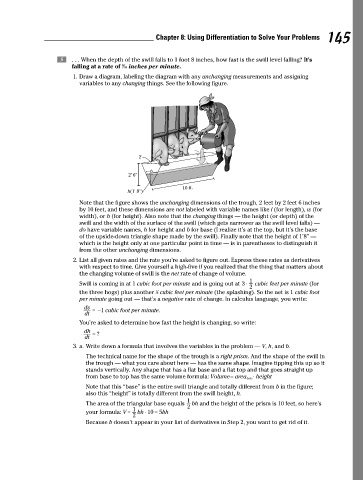
                         1. Draw a diagram, labeling the diagram with any unchanging measurements and assigning
                           variables to any changing things. See the following figure.


                                              2'
                                                  b
                                           2' 6"

                                                             10 ft.
                                           h(1' 8")
                           Note that the figure shows the unchanging dimensions of the trough, 2 feet by 2 feet 6 inches
                           by 10 feet, and these dimensions are not labeled with variable names like l (for length), w (for
                           width), or h (for height). Also note that the changing things — the height (or depth) of the
                           swill and the width of the surface of the swill (which gets narrower as the swill level falls) —
                           do have variable names, h for height and b for base (I realize it’s at the top, but it’s the base
                           of the upside-down triangle shape made by the swill). Finally note that the height of 1’8” —
                           which is the height only at one particular point in time — is in parentheses to distinguish it
                           from the other unchanging dimensions.
                         2. List all given rates and the rate you’re asked to figure out. Express these rates as derivatives
                           with respect to time. Give yourself a high-five if you realized that the thing that matters about
                           the changing volume of swill is the net rate of change of volume.
                                                                                   1
                           Swill is coming in at 1 cubic foot per minute and is going out at 3 $  cubic feet per minute (for
                                                                                   2
                                                    1
                           the three hogs) plus another  ⁄2 cubic feet per minute (the splashing). So the net is 1 cubic foot
                           per minute going out — that’s a negative rate of change. In calculus language, you write:
                            dv  = - 1 cubic foot per minute.
                             dt
                           You’re asked to determine how fast the height is changing, so write:
                            dh  =  ?
                             dt
                         3. a. Write down a formula that involves the variables in the problem — V, h, and b.
                             The technical name for the shape of the trough is a right prism. And the shape of the swill in
                             the trough — what you care about here — has the same shape. Imagine tipping this up so it
                             stands vertically. Any shape that has a flat base and a flat top and that goes straight up
                             from base to top has the same volume formula: Volume area base$  height
                                                                            =
                             Note that this “base” is the entire swill triangle and totally different from b in the figure;
                             also this “height” is totally different from the swill height, h.
                                                              1
                             The area of the triangular base equals  bh and the height of the prism is 10 feet, so here’s
                                            1                 2
                                                $
                             your formula: V =  bh 10 5 bh
                                                    =
                                            2
                             Because b doesn’t appear in your list of derivatives in Step 2, you want to get rid of it.

