


Page 164 - Calculus Workbook For Dummies
P. 164
148       Part III: Differentiation


                         5. Check whether this answer makes sense.
                           For this one, you’re on your own. Hint: Use the Pythagorean Theorem to calculate d ⁄50 second
                                                                                                  1
                           after the critical moment. Do you see why I picked this time increment?

                    g . . . Five feet before the man crashes into the lamp post, he’s running at a speed of
                         15 miles/hour. At this point, how fast is the tip of the shadow moving? It’s moving at
                         25 miles/hour.
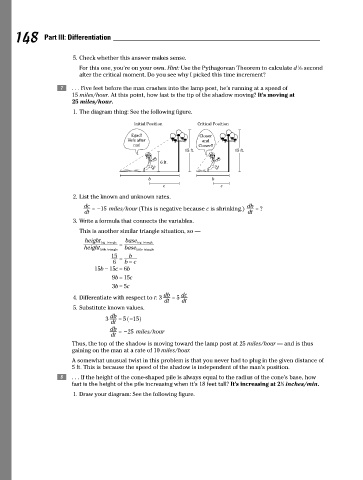
                         1. The diagram thing: See the following figure.

                                             Initial Position     Critical Position
                                            Egad!                 Closer
                                           Heís after              and
                                             me!                  Closer!!
                                                             15 ft.           15 ft.

                                                     6 ft.

                                                 b                    b
                                                      c                  c
                         2. List the known and unknown rates.
                            dc  = - 15  miles/hour (This is negative because c is shrinking.)   db  =  ?
                             dt                                                   dt
                         3. Write a formula that connects the variables.

                           This is another similar triangle situation, so —
                             height big triangle  base big triangle
                                        =
                            height little triangle  base little triangle
                                     15  =  b
                                      6   b -  c
                                15 b -  15 c =  6 b
                                       b 15
                                      9 =  c
                                      3 =  c
                                       b 5
                                                       db   dc
                         4. Differentiate with respect to t: 3  =  5
                                                       dt   dt
                         5. Substitute known values.
                                     db
                                         5 -
                                   3    = ^  15h
                                     dt
                                     db  = - 25  miles/hour
                                     dt
                         Thus, the top of the shadow is moving toward the lamp post at 25 miles/hour — and is thus
                         gaining on the man at a rate of 10 miles/hour.
                         A somewhat unusual twist in this problem is that you never had to plug in the given distance of
                         5 ft. This is because the speed of the shadow is independent of the man’s position.
                    h . . . If the height of the cone-shaped pile is always equal to the radius of the cone’s base, how
                                                                                             1
                         fast is the height of the pile increasing when it’s 18 feet tall? It’s increasing at 2 ⁄3 inches/min.
                         1. Draw your diagram: See the following figure.

