


Page 169 - Calculus Workbook For Dummies
P. 169
153
                                                    Chapter 8: Using Differentiation to Solve Your Problems


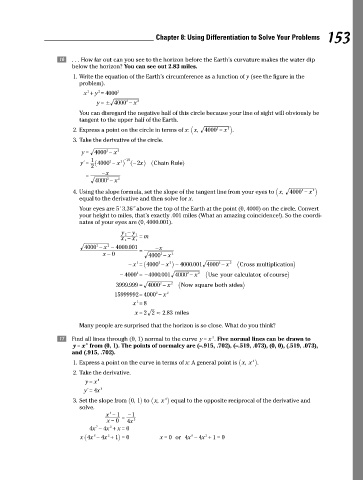
                    p . . . How far out can you see to the horizon before the Earth’s curvature makes the water dip
                         below the horizon? You can see out 2.83 miles.
                         1. Write the equation of the Earth’s circumference as a function of y (see the figure in the
                           problem).
                                 2
                              2
                            x +  y =  4000 2
                                          2
                                 y =  !  4000 -  x  2
                           You can disregard the negative half of this circle because your line of sight will obviously be
                           tangent to the upper half of the Earth.
                                                                           2
                                                                        2
                         2. Express a point on the circle in terms of x:  x ,  4000 -  x j.
                                                               `
                         3. Take the derivative of the circle.
                                    2
                            y =  4000 -  x  2
                               1     2  2  -  / 1 2
                           y = l  _ 4000 -  x i  ^ - 2 xh  ^ Chain Ruleh
                               2
                                  - x
                             =
                                    2
                                4000 -  x  2
                                                                                                    2
                                                                                                       2
                         4. Using the slope formula, set the slope of the tangent line from your eyes to  x ,  4000 -  x j
                                                                                           `
                           equal to the derivative and then solve for x.
                           Your eyes are 5' 3.36" above the top of the Earth at the point (0, 4000) on the circle. Convert
                           your height to miles, that’s exactly .001 miles (What an amazing coincidence!). So the coordi-
                           nates of your eyes are (0, 4000.001).
                                         y 2 -  y 1
                                         x 2 -  x 1  =  m
                                    2
                                 2
                             4000 -  x -  4000 .001  - x
                                   x -  0     =   4000 -  x  2
                                                      2
                                                                         2
                                              2
                                                     2
                                                        2
                                           -  x = _ 4000 -  x i  -  4000 .001 4000 -  x  2  _ Cross multiplicationi
                                              2
                                                              2
                                        -  4000 = - 4000 .001 4000 -  x  2  _ Use your calculator , ofcoursei
                                                     2
                                       3999 .999 =  4000 -  x  2  _ Now square both sidesi
                                                    2
                                              =
                                      15999992 4000 -  x  2
                                              2
                                            x =  8
                                             x =  2 2 .  . 2 83  miles
                           Many people are surprised that the horizon is so close. What do you think?
                                                                      4
                    q Find all lines through (0, 1) normal to the curve  y =  x . Five normal lines can be drawn to
                             4
                         y =  x from (0, 1). The points of normalcy are (–.915, .702), (–.519, .073), (0, 0), (.519, .073),
                         and (.915, .702).
                                                                                 ,
                                                                                    4
                         1. Express a point on the curve in terms of x: A general point is  x x i.
                                                                               _
                         2. Take the derivative.
                             y =  x  4
                            y = l  4 x  3
                                                       4
                         3. Set the slope from  ,0 1i to  x x i equal to the opposite reciprocal of the derivative and
                                                    ,
                                           _
                                                  _
                           solve.
                                     4
                                    x -  1  =  - 1
                                    x -  0  4 x  3
                                     3
                                7
                              4 x -  4 x + =  0
                                       x
                                6
                                    2
                                                                6
                                                                    2
                           x 4 x -  4 x + i  0       x =  0  or 4 x -  4 x + =  0
                                                                       1
                                       1 =
                             _

