


Page 170 - Calculus Workbook For Dummies
P. 170
154       Part III: Differentiation


                           Unless you have a special gift for solving 6th degree equations, you better use your
                                                     6
                                                         2
                                                            1
                           calculator — just graph  y =  4 x -  4 x + and find all of the x-intercepts. There are x-intercepts
                           at ~–.915, ~–.519, ~.519, and ~.915. Dig those palindromic numbers!
                                                         4
                         4. Plug these four solutions into  y =  x to get the y-coordinates. And there’s also the x = 0
                           no-brainer.
                                  4      4
                                         h
                            ^ - .519 = ^h  .519 =  + .073
                                  4      4
                                         h
                            ^ - .915 = ^h  .915 =  + .702
                                                                        4
                           You’re done. Five normal lines can be drawn to  y =  x from (0, 1). The points of normalcy are
                           (–.915, .702), (–.519, .073), (0, 0), (.519, .073), and (.915, .702).
                           I find this result interesting. First, because there are so many normal lines, and second,
                           because the normal lines from (0, 1) to (–.915, .702), (0, 0), and (.915, .702) are all shortest
                           paths (compared to other points in their respective vicinities). The other two normals are
                                                                4
                           longest paths. This is curious because  y =  x is everywhere concave toward (0, 1). When a
                           curve is concave away from a point, a normal to the curve can only be a local shortest path.
                           But when a curve is concave toward a point, you can get either a local shortest or a local
                           longest path.
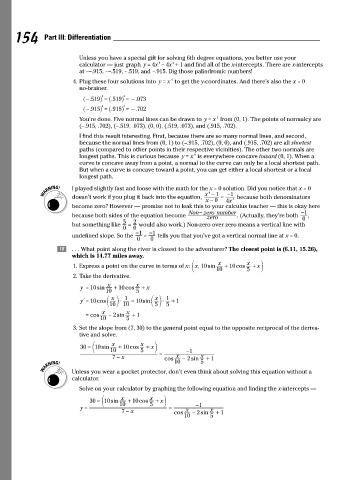
                         I played slightly fast and loose with the math for the x = 0 solution. Did you notice that x = 0
                                                                     4
                                                                    x -  1  - 1
                         doesn’t work if you plug it back into the equation,   =  3 because both denominators
                                                                    x -  0  4 x
                         become zero? However — promise not to leak this to your calculus teacher — this is okay here
                                                                  -
                                                               Non zero number                     - 1
                         because both sides of the equation become   zero     . (Actually, they’re both   0  ,
                                         5   2
                         but something like   =  would also work.) Non-zero over zero means a vertical line with
                                         0   0
                                             - 1  - 1
                         undefined slope. So the   =  tells you that you’ve got a vertical normal line at x = 0.
                                              0   0
                    r . . . What point along the river is closest to the adventurer? The closest point is (6.11, 15.26),
                         which is 14.77 miles away.
                                                                        x         x
                         1. Express a point on the curve in terms of x:  x 10 sin  +  10 cos  +  xm
                                                                  ,
                                                                c
                                                                        10        5
                         2. Take the derivative.
                                    x        x
                           y =  10  sin  +  10 cos  +  x
                                    10       5
                                     x    1         x  1
                           y = l  10  cosc  $ m  -  10 sinc m  $  +  1
                                     10  10         5  5
                                  x       x
                             =  cos  -  2 sin  +  1
                                  10      5
                         3. Set the slope from (7, 30) to the general point equal to the opposite reciprocal of the deriva-
                           tive and solve.
                                      x        x
                           30 - c 10 sin  +  10 cos  +  xm
                                     10        5              - 1
                                                     =
                                      7 -  x           cos  x  -  2 sin  x  +  1
                                                          10       5
                         Unless you wear a pocket protector, don’t even think about solving this equation without a
                         calculator.
                           Solve on your calculator by graphing the following equation and finding the x-intercepts —
                                         x        x
                              30 - c 10 sin  +  10 cos  +  xm
                                        10        5              - 1
                           y =                          -
                                         7 -  x           cos  x  -  2 sin  x  +  1
                                                             10       5

