


Page 165 - Calculus Workbook For Dummies
P. 165
149
                                                    Chapter 8: Using Differentiation to Solve Your Problems


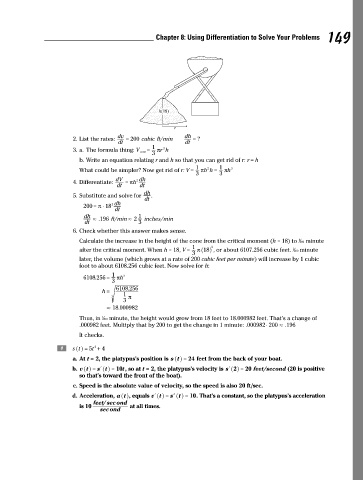
                                                     h(18)


                                                          r
                                       dv                    dh
                         2. List the rates:   =  200  cubic ft/min  =  ?
                                        dt                    dt
                                                   1  2
                         3. a. The formula thing: V cone =  π r h
                                                   3
                           b. Write an equation relating r and h so that you can get rid of r: r h
                                                                                   =
                                                                 1   2   1   3
                           What could be simpler? Now get rid of r: V =  π h h =  π h
                                                                 3       3
                                       dV     2 dh
                         4. Differentiate:   =  π h
                                       dt      dt
                                                dh
                         5. Substitute and solve for   .
                                                dt
                            200 = $   2  dh
                                 π 18
                                       dt
                            dh  .  .196  ft/min .  2  1  inches/min
                             dt               3
                         6. Check whether this answer makes sense.
                           Calculate the increase in the height of the cone from the critical moment (h = 18) to  ⁄200 minute
                                                                                                   1
                                                                1     3
                           after the critical moment. When h = 18, V =  π 18h , or about 6107.256 cubic feet.  ⁄200 minute
                                                                                                 1
                                                                   ^
                                                                3
                           later, the volume (which grows at a rate of 200 cubic feet per minute) will increase by 1 cubic
                           foot to about 6108.256 cubic feet. Now solve for h:
                                      1
                            6108 .256 =  π h  3
                                      3
                                       6108 .256
                                  h =
                                     3   1  π
                                         3
                                    .  18 .000982
                                  1
                           Thus, in  ⁄200 minute, the height would grow from 18 feet to 18.000982 feet. That’s a change of
                                                                                        $
                           .000982 feet. Multiply that by 200 to get the change in 1 minute: .000982 200 .  .196
                           It checks.
                    i    s t =  t 5 +  4
                                2
                          ^ h
                         a. At t = 2, the platypus’s position is s t =  24 feet from the back of your boat.
                                                          ^ h
                         b. v t = l ^h  s t =  10 t, so at t = 2, the platypus’s velocity is s 2 =  20 feet/second (20 is positive
                                    h
                            ^
                                                                            l ^ h
                           so that’s toward the front of the boat).
                         c. Speed is the absolute value of velocity, so the speed is also 20 ft/sec.
                         d. Acceleration, a t ^ h, equals v t = m ^h  s t =  10. That’s a constant, so the platypus’s acceleration
                                                   l ^
                                                            h
                               feet / second
                           is 10           at all times.
                                  second

