


Page 176 - Calculus Workbook For Dummies
P. 176
160       Part IV: Integration and Infinite Series


                Q.   Using 10 right rectangles, estimate the area    y
                     under f x =  lnx from 1 to 6.
                           ^ h
                                                                                                   (6, ~1.8)
                A.   The approximate area is 6.181.                 2
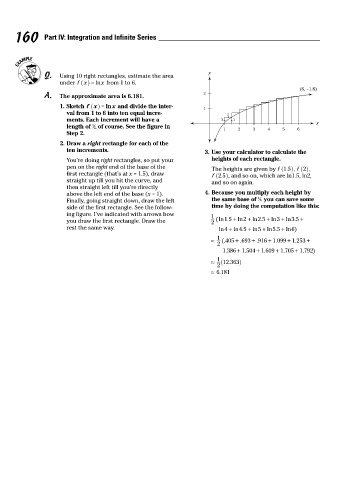
                     1. Sketch f x =  lnx and divide the inter-     1
                               ^ h
                       val from 1 to 6 into ten equal incre-               2
                       ments. Each increment will have a                 3   1
                                                                                                        x
                       length of  ⁄2, of course. See the figure in
                               1
                                                                          1    2    3   4    5    6
                       Step 2.
                     2. Draw a right rectangle for each of the
                       ten increments.                              3. Use your calculator to calculate the
                       You’re doing right rectangles, so put your     heights of each rectangle.
                       pen on the right end of the base of the        The heights are given by f 1 ^  .5h, f 2 ^ h,
                       first rectangle (that’s at x = 1.5), draw      f ^  . 2 5h, and so on, which are ln1.5, ln2,
                       straight up till you hit the curve, and        and so on again.
                       then straight left till you’re directly
                       above the left end of the base (x = 1).      4. Because you multiply each height by
                                                                                     1
                       Finally, going straight down, draw the left    the same base of  ⁄2, you can save some
                       side of the first rectangle. See the follow-   time by doing the computation like this:
                       ing figure. I’ve indicated with arrows how     1
                                                                           .5
                       you draw the first rectangle. Draw the         2  (ln1 +  ln2 +  ln2 .5 +  ln3 +  ln3 .5 +
                       rest the same way.                                ln4 +  ln4 .5 +  ln5 +  ln5 .5 +  ln6 )
                                                                        1
                                                                      .  (.405 +  .693 +  .916 +  . 1 099 +  . 1 253 +
                                                                        2
                                                                           . 1 386 +  . 1 504 +  . 1 609 +  . 1 705 +  . 1 792 )
                                                                        1
                                                                      .  ^ 12 .363h
                                                                        2
                                                                      .  . 6 181

