


Page 178 - Calculus Workbook For Dummies
P. 178
162       Part IV: Integration and Infinite Series


                Sigma Notation and Reimann

                Sums: Geek Stuff


                          Now that you’re warmed up, let’s segue into summing some sophisticated sigma sums.
                          Sigma notation may look difficult, but it’s really just a shorthand way of writing a
                          long sum.

                          In a sigma sum problem, you can pull anything through the sigma symbol to the out-
                          side except for a function of the index of summation (the i in the following example).
                          Note that you can use any letter you like for the index of summation, though i and k
                          are customary.


                             12
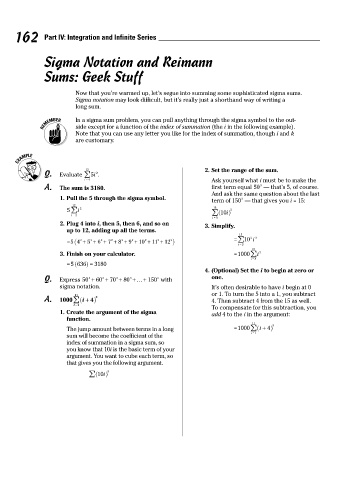
                Q.   Evaluate !  i 5 .                              2. Set the range of the sum.
                                2
                             i =  4                                   Ask yourself what i must be to make the
                A.   The sum is 3180.                                 first term equal 50 — that’s 5, of course.
                                                                                      3
                                                                      And ask the same question about the last
                     1. Pull the 5 through the sigma symbol.                    3
                                                                      term of 150 — that gives you i = 15:
                         12
                                                                       15
                       5  i !  2                                      !^ 10 ih 3
                        i =  4
                                                                      i =  5
                     2. Plug 4 into i, then 5, then 6, and so on    3. Simplify.
                       up to 12, adding up all the terms.
                                                                               15
                                                                             =!  10  3 i  3
                               2
                                                2
                                                     2
                                                         2
                                            2
                                  2
                                     2
                                         2
                        5 4 +
                       = _  2  5 +  6 +  7 +  8 +  9 +  10 +  11 +  12 i
                                                                               i =  5
                                                                                   15
                     3. Finish on your calculator.                           = 1000  i !  3
                                                                                   i =  5
                        5 636 =
                       = ^   h  3180
                                                                    4. (Optional) Set the i to begin at zero or
                Q.   Express 50 +  60 +  70 +  80 + ... 150 with      one.
                                           3
                                                    3
                                   3
                              3
                                       3
                                                +
                     sigma notation.                                  It’s often desirable to have i begin at 0
                         11
                A.  1000!^  i +  4h 3                                 or 1. To turn the 5 into a 1, you subtract
                                                                      4. Then subtract 4 from the 15 as well.
                          =
                         i 1
                                                                      To compensate for this subtraction, you
                     1. Create the argument of the sigma              add 4 to the i in the argument:
                       function.
                                                                                   11
                                                                                          3
                       The jump amount between terms in a long               = 1000!^ i +  4h
                                                                                   i 1
                                                                                    =
                       sum will become the coefficient of the
                       index of summation in a sigma sum, so
                       you know that 10i is the basic term of your
                       argument. You want to cube each term, so
                       that gives you the following argument.
                                    3
                              !^ 10 ih

