Page 179 - Calculus Workbook For Dummies
P. 179
163
                                                                         Chapter 9: Getting into Integration


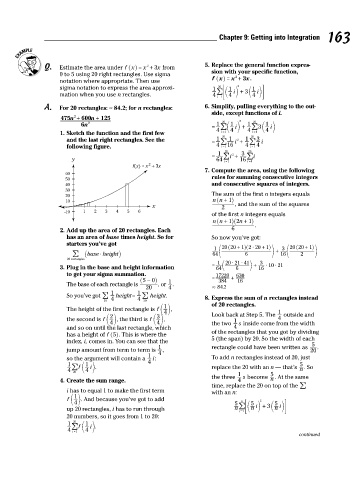
                Q.   Estimate the area under f x =  x +  3 x from   5. Replace the general function expres-
                                                 2
                                           ^ h
                     0 to 5 using 20 right rectangles. Use sigma      sion with your specific function,
                                                                              2
                                                                        ^ h
                     notation where appropriate. Then use             f x =  x +  3 x.
                     sigma notation to express the area approxi-      1  20  1  2  1
                                                                        ! c >
                     mation when you use n rectangles.                4 i 1  4  i + cm  3  4  imH
                                                                         =
                A.   For 20 rectangles: ≈ 84.2; for n rectangles:   6. Simplify, pulling everything to the out-
                                                                      side, except functions of i.
                         2
                     475 n +  600 n +  125                                     2
                            6 n 2                                       1  20  1  1  20  1
                                                                      = !c    i + ! cm  3  im
                                                                                    =
                     1. Sketch the function and the first few           4 i 1  4  4 i 1  4
                                                                          =
                                                                          20       20
                                                                        1
                                                                                 1
                       and the last right rectangles. See the         = !   1  i + ! 3  i
                                                                               2
                       following figure.                                4 i 1 16  4 i 1  4
                                                                                   =
                                                                          =
                                                                          20
                                                                        1
                                                                      = !   i +  3  20  i !
                                                                             2
                         y                                              64 i 1  16 i 1
                                                                           =
                                                                                  =
                                                  2
                                            f(x) = x   + 3x
                                                                    7. Compute the area, using the following
                      60
                      50                                              rules for summing consecutive integers
                      40                                              and consecutive squares of integers.
                      30
                      20                                              The sum of the first n integers equals
                                                                        ^
                      10                                              n n +  1h
                                                   x                     2    , and the sum of the squares
                      -10   1   2  3   4   5  6
                                                                      of the first n integers equals
                                                                      n n +  1 2 ^h  n +  1h
                                                                        ^
                                                                                    .
                     2. Add up the area of 20 rectangles. Each               6
                       has an area of base times height. So for       So now you’ve got:
                       starters you’ve got
                                                                                1 2 20 +
                                                                            ^
                                                                                                  ^
                                                                       1  f  20 20 + h ^  $  1h p  +  3  f  20 20 +  1h  p
                                  $
                         ! _  base heighti                            64         6           16    2
                       20 rectangles
                                                                                $
                                                                             $
                                                                        1  20 21 41   3
                                                                                           $
                     3. Plug in the base and height information       =  64 c  6   m  +  16  $  10 21
                       to get your sigma summation.                     17220  630
                                               ^ 5 -  0h  1           =  384  +  16
                       The base of each rectangle is   , or  .
                                                 20     4             .  84 .2
                                              1
                       So you’ve got !  1  height= !  height.
                                   20  4      4  20                 8. Express the sum of n rectangles instead
                                                       1              of 20 rectangles.
                       The height of the first rectangle is f c m,
                                                       4                                    1
                                     2              3                 Look back at Step 5. The   outside and
                       the second is f c m, the third is f c m,              1              4
                                     4              4                 the two   s inside come from the width
                       and so on until the last rectangle, which             4
                       has a height of f 5 ^ h. This is where the     of the rectangles that you got by dividing
                       index, i, comes in. You can see that the       5 (the span) by 20. So the width of each
                                                     1                rectangle could have been written as   5  .
                       jump amount from term to term is  ,                                            20
                                                 1   4
                       so the argument will contain a  i:             To add n rectangles instead of 20, just
                       1     1                   4                                                 5
                           f ! c  im.                                 replace the 20 with an n — that’s  . So
                                                                                                   n
                       4 20  4
                                                                                         5
                                                                      the three   1  s become  . At the same
                     4. Create the sum range.                                  4         n
                                                                      time, replace the 20 on top of the !
                       i has to equal 1 to make the first term        with an n:
                         1
                       f c m. And because you’ve got to add                     n     2
                         4                                                    5    5       5
                       up 20 rectangles, i has to run through                 n  ! c >  n  i + cm  3  n  imH
                                                                               i 1=
                       20 numbers, so it goes from 1 to 20:
                       1  20  1
                           f ! c  im.
                       4 i 1=  4
                                                                                                   continued
   174   175   176   177   178   179   180   181   182   183   184