


Page 184 - Calculus Workbook For Dummies
P. 184
168       Part IV: Integration and Infinite Series


                Finding Area with the Trapezoid

                Rule and Simpson’s Rule


                          To close this chapter, I give you two more ways to approximate an area. You can use
                          these methods when finding the exact area is impossible. (Just take my word for it that
                          there are functions that can’t be handled with ordinary integration.) With the trape-
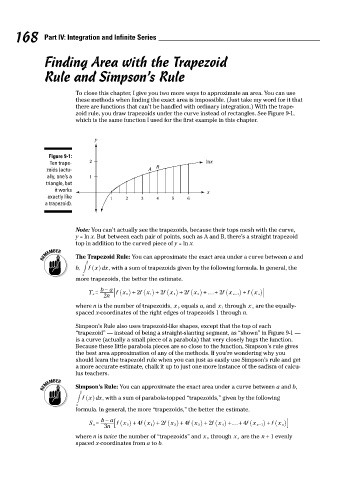
                          zoid rule, you draw trapezoids under the curve instead of rectangles. See Figure 9-1,
                          which is the same function I used for the first example in this chapter.


                                y

                 Figure 9-1:
                 Ten trape-   2                                     lnx
                zoids (actu-                     A  B
                ally, one’s a  1
                triangle, but
                   it works                                          x
                 exactly like        1    2    3    4    5    6
                a trapezoid).


                          Note: You can’t actually see the trapezoids, because their tops mesh with the curve,
                          y = ln x. But between each pair of points, such as A and B, there’s a straight trapezoid
                          top in addition to the curved piece of y = ln x.

                          The Trapezoid Rule: You can approximate the exact area under a curve between a and
                             b
                              f x dx, with a sum of trapezoids given by the following formula. In general, the
                          b,  # ^ h
                            a
                          more trapezoids, the better the estimate.
                                  b -  a
                                                                       +
                                               f x 1 +
                                                              f x 3 +
                                                      f x 2 +
                              T n =   9 f x 0 +  2 _  i  2 _  i  2 _  i  ... 2 _  f x n iC
                                                                          f x n 1 + _i
                                        _
                                           i
                                   2 n                                        -
                          where n is the number of trapezoids, x 0 equals a, and x 1 through x n are the equally-
                          spaced x-coordinates of the right edges of trapezoids 1 through n.
                          Simpson’s Rule also uses trapezoid-like shapes, except that the top of each
                          “trapezoid” — instead of being a straight-slanting segment, as “shown” in Figure 9-1 —
                          is a curve (actually a small piece of a parabola) that very closely hugs the function.
                          Because these little parabola pieces are so close to the function, Simpson’s rule gives
                          the best area approximation of any of the methods. If you’re wondering why you
                          should learn the trapezoid rule when you can just as easily use Simpson’s rule and get
                          a more accurate estimate, chalk it up to just one more instance of the sadism of calcu-
                          lus teachers.
                          Simpson’s Rule: You can approximate the exact area under a curve between a and b,
                           b
                            f x dx, with a sum of parabola-topped “trapezoids,” given by the following
                           # ^ h
                          a
                          formula. In general, the more “trapezoids,” the better the estimate.
                                  b -  a
                                                              f x 3 +
                                                       f x 2 +
                                                                      f x 4 +
                                                                               +
                                               f x 1 +
                              S n =   9 f x 0 +  4 _  i  2 _  i  4 _  i  2 _  i  ... 4 _  f x n iC
                                        _
                                                                                 f x n 1 + _i
                                           i
                                   3 n                                                -
                                                                                         1
                          where n is twice the number of “trapezoids” and x 0 through x n are the n + evenly
                          spaced x-coordinates from a to b.

