


Page 189 - Calculus Workbook For Dummies
P. 189
173
Chapter 9: Getting into Integration
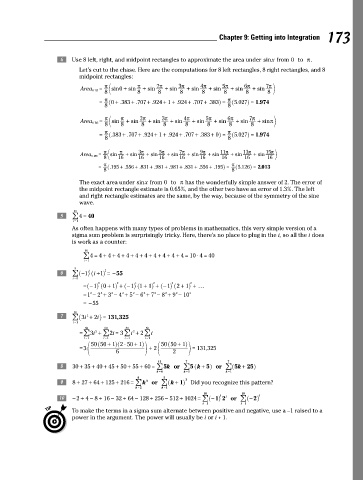
d Use 8 left, right, and midpoint rectangles to approximate the area under sinx from 0 to π.
Let’s cut to the chase. Here are the computations for 8 left rectangles, 8 right rectangles, and 8
midpoint rectangles:
π π 2 π 3 π 4 π 5 π 6 π 7 π
Area LR8 = c sin0 + sin + sin + sin + sin + sin + sin + sin m
8 8 8 8 8 8 8 8
π π
1
= ^ 0 + .383 + .707 + .924 + + .924 + .707 + .383 = ^ . 5 027 = . 1 974
h
h
8 8
π π 2 π 3 π 4 π 5 π 6 π 7 π
= c sin + sin + sin + sin + sin + sin + sin + sinπm
Area RR8
8 8 8 8 8 8 8 8
π π
0 =
1
= ^ .383 + .707 + .924 + + .924 + .707 + .383 + h ^ . 5 027 = . 1 974
h
8 8
π π 3 π 5 π 7 π 9 π 11 π 13 π 15 π
Area 8 MR = 8 c sin 16 + sin 16 + sin 16 + sin 16 + sin 16 + sin 16 + sin 16 + sin 16 m
π π
= ^ .195 + .556 + .831 + .981 + .981 + .831 + .556 + .195 = ^ . 5 126 = . 2 013
h
h
8 8
The exact area under sinx from 0 to π has the wonderfully simple answer of 2. The error of
the midpoint rectangle estimate is 0.65%, and the other two have an error of 1.3%. The left
and right rectangle estimates are the same, by the way, because of the symmetry of the sine
wave.
10
e ! 4 = 40
=
i 1
As often happens with many types of problems in mathematics, this very simple version of a
sigma sum problem is surprisingly tricky. Here, there’s no place to plug in the i, so all the i does
is work as a counter:
10
! 4 = + + + + + + + + + = 10 4 = 40
$
4
4
4
4
4
4
4
4
4
4
i 1
=
9 i 2
f !^ - 1 ^h i 1 = - 55
+ h
i = 0
0 2 1 2 2 2
1 +
1 + -
= - 1 ^h 0 + h ^ 1 1 + h ^ 1 ^h 2 + h ...
1 + - h
^
^
2
2
2
2
2
2
2
2
2
= 1 - 2 + 3 - 4 + 5 - 6 + 7 - 8 + 9 - 10 2
= - 55
50
2
g !_ i 3 + i 2 i = 131 ,325
=
i 1
50
50
50
50
=! i 3 + ! i 2 = ! i + ! i
2
2
3
2
i 1 i 1 i 1 i 1
=
=
=
=
1 2 50 +
50 50 + h ^ $ 1h 50 50 + 1h
^
^
= 3 e o + 2 e o = 131 ,325
6 2
12 7 7
h 30 + 35 + 40 + 45 + 50 + 55 + 60 = ! 5 k or ! ^ k + 5h or !^ 5 k + 25h
5
=
=
k = 6 k 1 k 1
6 5 3
i 8 + 27 + 64 + 125 + 216 = ! k 3 or !^ k + 1h Did you recognize this pattern?
k 2 k 1
=
=
10 i 10 i
j - 2 + - + 16 - 32 + 64 - 128 + 256 - 512 + 1024 = !^ - h i or !^ - 2h
4
1 2
8
i 1 i 1
=
=
To make the terms in a sigma sum alternate between positive and negative, use a –1 raised to a
power in the argument. The power will usually be i or i + 1.

