


Page 196 - Calculus Workbook For Dummies
P. 196
180       Part IV: Integration and Infinite Series


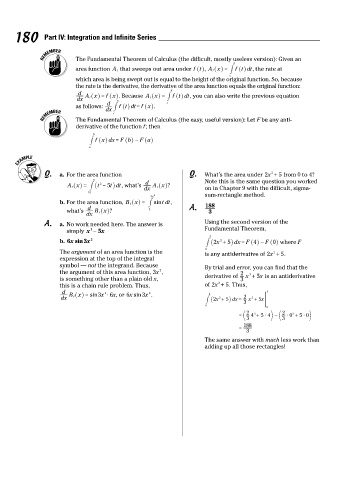
                          The Fundamental Theorem of Calculus (the difficult, mostly useless version): Given an
                                                                             x
                                                                      f ^
                          area function  A f that sweeps out area under f t ^ h,  A x = # ^h  f t dt, the rate at
                                                                                 h
                                                                            s
                          which area is being swept out is equal to the height of the original function. So, because
                          the rate is the derivative, the derivative of the area function equals the original function:
                                                         x
                           d  A x = ^h  f xh. Because  A x = # ^h  f t dt, you can also write the previous equation
                          dx  f ^      x          f ^       h
                          as follows:   d  # ^ h  = ^  s
                                        f t dt f xh.
                                    dx
                                      s
                          The Fundamental Theorem of Calculus (the easy, useful version): Let F be any anti-
                          derivative of the function f ; then
                               b
                                f x dx F b -
                                                ^
                               # ^ h   =  ^ h  F ah
                              a
                Q.   a. For the area function                  Q.   What’s the area under  x2  2  +  5 from 0 to 4?
                               x                                    Note this is the same question you worked
                                  2
                                     t dt, what’s
                        f ^ h
                       A x = # _ t -  5 i        d  A xh?
                                                    f ^
                                                dx                  on in Chapter 9 with the difficult, sigma-
                              10
                                                  3 x  2            sum-rectangle method.
                     b. For the area function, B x = # sint dt,
                                            f ^ h
                              d                  -  4          A.   188
                       what’s   B xh?                                3
                                 f ^
                             dx
                A.   a. No work needed here. The answer is          Using the second version of the
                               2
                       simply x -  5 x                              Fundamental Theorem,
                                                                     4
                     b. x6  sin x  2                                 # _ 2 x +  5i  dx F 4 -  F 0 ^ h where F
                            3
                                                                         2
                                                                                =
                                                                                   ^ h
                                                                    0
                     The argument of an area function is the        is any antiderivative of  x2  2  +  5.
                     expression at the top of the integral
                     symbol — not the integrand. Because            By trial and error, you can find that the
                                                     2
                     the argument of this area function,  x3 ,                  2  3
                     is something other than a plain old x,         derivative of   3  x +  5 x is an antiderivative
                     this is a chain rule problem. Thus,            of  x2  2  +  5. Thus,
                     d        sin x3 $            2                  4                  4 V
                                   2
                                               3
                         f ^ h
                     dx  B x =       6  , x or  x6  sin x  .         # _ 2 x +  5i  dx =  2  x +  5 x  W
                                                                                   3
                                                                         2
                                                                                 3      W W
                                                                    0
                                                                                        X 0
                                                                                  2          2
                                                                                                 3
                                                                                    3
                                                                                      5 4 - cm
                                                                               = c  4 + $      $  0 + $
                                                                                                   5 0m
                                                                                  3          3
                                                                                 188
                                                                               =
                                                                                  3
                                                                    The same answer with much less work than
                                                                    adding up all those rectangles!

