


Page 118 - Carbon Nanotubes
P. 118
Hemi-toroidal networks in pyrolytic carbon nanotubes       107


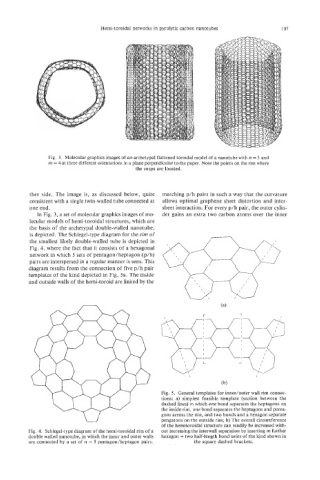
                 Fig. 3.  Molecular graphics images of an archetypal flattened toroidal model of a nanotube with n = 5 and
                 m = 4 at three different orientations in a plane perpendicular to the paper. Note the points on the rim where
                                             the cusps are located.


           ther  side.  The  image  is,  as  discussed below,  quite   matching p/h  pairs in such a way that the curvature
           consistent with a single twin-walled tube connected at   allows optimal graphene sheet distortion  and inter-
           one end.                                   sheet interaction. For every p/h pair, the outer cylin-
             In Fig. 3, a set of molecular graphics images of mo-   der gains an extra two carbon atoms over the inner
           lecular models of hemi-toroidal structures, which are
           the basis of  the archetypal double-walled nanotube,
           is depicted. The Schlegel-type diagram for the rim of
           the smallest likely double-walled tube is depicted in
           Fig. 4, where the fact that it consists of a hexagonal
           network in which 5 sets of pentagodheptagon (p/h)
           pairs are interspersed in a regular manner is seen. This
                                                      g[-1g
           diagram results from the connection of five p/h  pair
           templates of  the kind depicted in Fig. 5a. The inside
           and outside walls of the hemi-toroid are linked by the


                                                            \
                                                            \


                                                             \      I  I  I-    I      I  I  I
                                                             \      L          A      I
                                                              \                       i
                                                              \                       /
                                                               \                     /
                                                               \                     i
                                                                         (b)
                                                      Fig.  5.  General templates for inner/outer wall rim connec-
                                                      tions:  a)  simplest  feasible  template  (section  between  the
                                                      dashed lines) in which one bond separates the heptagons on
                                                      the inside rim, one bond separates the heptagons and penta-
                                                      gons across the rim, and two bonds and a hexagon separate
                                                      pengatons on the outside rim; b) The overall circumference
                                                      of the hemitoroidal structure can readily be increased with-
           Fig.  4.  Schlegel-type diagram of the hemi-toroidal rim of a   out increasing the interwall separation by inserting rn further
           double walled nanotube, in which the inner and outer walls   hexagon + two half-length bond units of the kind shown in
           are connected by a set of  n = 5  pentagon/heptagon  pairs.   the square dashed brackets.

