


Page 117 - Carbon Nanotubes
P. 117
106                                 A. SARKAR al.
                                                         et
             value was chosen deltaf  = 65 nm, where the sin(x)  ary growth showed no regular structure in the HRTEM
             transfer function has a large plateau at sin(x) ca. -1   images (Fig. l), suggesting that it might consist largely
             against the interlayer spacing of  carbon in the range   of some form of “amorphous” carbon. After the sec-
             5.0-2.8  A. These conditions were optimum for observ-  ond stage of  heat  treatment, at 28OO0C, the  amor-
             ing high-contrast 002 lattice fringes form the PCNTs.   phous  sheaths  graphitise  to  a  very  large  degree,
               The  simulations were  carried  out  on a  Silicon   producing multi-walled graphite nanotubes which tend
             Graphics Iris Indigo workstation using the CERIUS  to be sealed off at points where the spindle-like for-
             molecular modeling and the associated HRTEM mod-   mations are thinnest. The sealed-off end region of one
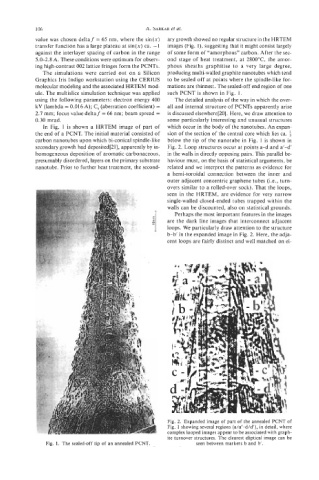
             ule. The multislice simulation technique was applied   such PCNT is shown in Fig.  1.
             using the following parameters:  electron energy 400   The detailed analysis of the way in which the over-
             kV (lambda = 0.016 A); C, (aberration coefficient) =  all and internal structure of PCNTs apparently arise
             2.7 mm; focus value deltaf  = 66 nm; beam spread =  is discussed elsewhere[20]. Here, we draw attention to
             0.30 mrad.                                 some particularly interesting  and unusual structures
               In  Fig.  1 is  shown  a  HRTEM image of  part  of   which occur in the body of the nanotubes. An expan-
             the end of  a PCNT. The initial material consisted of   sion of the section of the central core which lies ca. f
             carbon nanotubes upon which bi-conical spindle-like   below the tip of  the nanotube in Fig.  1  is shown in
             secondary growth had deposited[21], apparently by in-   Fig. 2. Loop structures occur at points a-d  and a‘-d‘
             homogeneous deposition of aromatic carbonaceous,   in the walls in directly opposing pairs. This parallel be-
             presumably disordered, layers on the primary substrate   haviour must, on the basis of statistical arguments, be
             nanotube. Prior to further heat treatment, the second-  related and we interpret the patterns as evidence for
                                                        a  hemi-toroidal  connection  between  the  inner  and
                                                        outer adjacent concentric graphene tubes (Le., turn-
                                                        overs similar to a rolled-over sock). That the loops,
                                                        seen in  the HRTEM, are evidence for very  narrow
                                                        single-walled closed-ended tubes trapped  within  the
                                                        walls can be discounted, also on statistical grounds.
                                                          Perhaps the most important features in the images
                                                        are the dark line images that  interconnect  adjacent
                                                        loops. We particularly draw attention to the structure
                                                        b-b‘  in the expanded image in Fig. 2. Here, the adja-
                                                        cent loops are fairly distinct and well matched on ei-


                                                        Fig. 2.  Expanded image of part of the annealed PCNT of
                                                        Fig.  1 showing several regions (a/a’-d/d‘),  in detail, where
                                                        complex looped images appear to be associated with graph-
                                                        ite turnover structures. The clearest eliptical image can be
                Fig.  1.  The sealed-off tip of an annealed PCNT   seen between markers b and b’.

