


Page 119 - Carbon Nanotubes
P. 119
I08                                 A. SARKAR et al.
             one. The number of p/h  pairs determines the wall sep-  workstation operating the Cerius Molecular Mechan-
             aration and, for five such pairs, the circumference of   ics Programme. The results, at a series of angles (0, 5,
             the outer wall gains 10 extra atoms and the difference   10, and 15')  to the normal in a plane perpendicular to
             in the radius increases by ca. 3.5 A-very  close to the   the paper, are shown diagrammatically in Fig. 6a. The
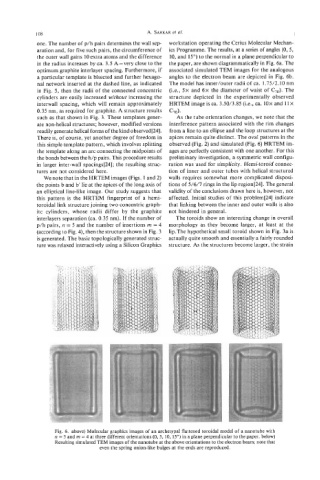
             optimum graphite interlayer spacing. Furthermore, if   associated simulated TEM images for the analogous
             a particular template is bisected and further hexago-   angles to the electron beam are depicted in Fig. 6b.
             nal network inserted at the dashed line, as indicated   The model has inner/outer  radii of ca.  1.75/2.10 nm
             in Fig. 5, then the radii of  the connected concentric   (Le., 5x and 6x the diameter of waist of C7,J.  The
             cylinders are easily increased without  increasing the   structure  depicted  in  the  experimentally  observed
             interwall  spacing,  which will  remain  approximately   HRTEM image is ca. 3.50/3.85 (Le., ca. lox and llx
             0.35 nm, as required for graphite. A structure results   c70)*
             such as that shown in Fig. 3. These templates gener-   As the tube orientation changes, we note that the
             ate non-helical structures; however, modified versions  interference pattern associated with the rim changes
             readily generate helical forms of the kind observed[24].   from a line to an ellipse and the loop structures at the
             There is, of course, yet another degree of freedom in   apices remain quite distinct. The oval patterns in the
             this simple template pattern, which involves splitting   observed (Fig. 2) and simulated (Fig. 6) HRTEM im-
             the template along an arc connecting the midpoints of   ages are perfectly consistent with one another. For this
             the bonds between the h/p pairs. This procedure results  preliminary investigation, a symmetric wall configu-
             in larger inter-wall spacings[24]; the resulting struc-  ration was used for simplicity. Hemi-toroid connec-
             tures are not considered here.             tion of inner and outer tubes with helical structured
                We note that in the HRTEM images (Figs. 1 and 2)   walls requires  somewhat more complicated disposi-
             the points b and b'  lie at the apices of the long axis of   tions of 5/6/7 rings in the lip region[24]. The general
             an elliptical line-like image. Our study suggests that   validity of the conclusions drawn here is, however, not
             this  pattern  is  the  HRTEM  fingerprint  of  a hemi-  affected.  Initial studies of this problem[24] indicate
             toroidal link structure joining two concentric graph-   that linking between the inner and outer walls is also
             ite  cylinders,  whose  radii  differ  by  the  graphite  not hindered in general.
             interlayers separation (ca. 0.35 nm). If the number of   The toroids show an interesting change in overall
             p/h pairs, n = 5  and the number of insertions m = 4  morphology  as  they  become  larger,  at  least  at  the
             (according to Fig. 4), then the structure shown in Fig. 3   1ip.The hypothetical small toroid shown in Fig. 3a is
             is generated. The basic topologically generated struc-  actually quite smooth and essentially a fairly rounded
             ture was relaxed interactively using a Silicon Graphics  structure. As the structures become larger, the strain


                                               -   -


                                                      I
                                                      i


                   Fig. 6.  above) Molecular graphics images of an archetypal flattened toroidal model of a nanotube with
                   n = 5 and rn = 4 at three different orientations (0,5, 10, 15") in a plane perpendicular to the paper. below)
                   Resulting simulated TEM images of the nanotube at the above orientations to the electron beam; note that
                                  even the spring onion-like bulges at the ends are reproduced.

