


Page 138 - Catalysts for Fine Chemical Synthesis Vol 1 - Robert & Poignant
P. 138
asymmetric reduction of ketones 125
argon atmosphere. After stirring for 10 minutes, tert-butyl(dimethyl)pho-
sphine±borane (1) (4.9 g) in diethyl ether (40 mL) was added, and the
mixture was stirred at ÿ65 8C for 3 hours. Dry copper (II) chloride (6.2 g)
was added in one portion, and the mixture was gradually warmed to room
temperature over 2 hours.
6. After stirring for 1 hour, 25 % aqueous ammonia (50 mL) was added
dropwise. The organic layer was separated and aqueous layer was extracted
with ethyl acetate (200 mL, twice). The combined extracts were washed
with 5 % aqueous ammonia (100 mL), 2 M hydrochloric acid, and brine,
and then dried over sodium sulfate, and concentrated in vacuo.
7. The residual solid was recrystallized from toluene twice to afford (S,S)-1,2-
bis(boranato(tert-butyl)methylphosphino)ethane (2) 1.89 g (39 %) as white
crystals [a] 27 ÿ9:1 (c 1:0, CHCl 3 ).
D
8. In a Schlenk tube equipped with a magnetic stirrer bar were placed (S,S)-1,2-
bis(boranato(tert-butyl)methylphosphino)ethane (2) (131 mg) and dry tolu-
ene (4 mL) under an argon atmosphere at 0 8C. To this solution, trifluoro-
methanesulfonic acid (0.22 mL) was added over a period of 5 minutes.
9. After stirring at 0 8C for 30 minutes and at room temperature for 1 hour, the
solvent was removed in vacuo. The resulting pasty oil was dissolved in
degassed ethanol/water (10/1) containing potassium hydroxide (280 mg),
and stirred at 50 8C for 90 minutes. After cooling to room temperature,
degassed diethyl ether (5 mL) was added, and the upper layer was collected
through a cannula. The extraction was repeated three times. The combined
extracts were dried over sodium sulfate. The solution was passed through a
column of basic alumina (13 g) using degassed diethyl ether (30 mL) under
an argon atmosphere.
10. The resulting solution was concentrated in vacuo to afford (S,S)-1,2-
bis(tert-butylmethylphosphino)ethane (BisP*) as a solid or an oil.
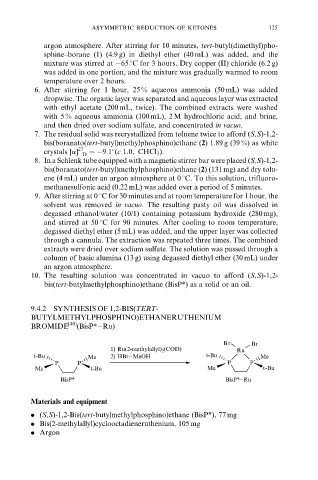
9.4.2 SYNTHESIS OF 1,2-BIS(TERT-
BUTYLMETHYLPHOSPHINO)ETHANERUTHENIUM
BROMIDE [40] (BisP*ÿRu)
Br Br
1) Ru(2-methylallyl) 2 (COD) Ru
t-Bu Me 2) HBr−MeOH t-Bu Me
P P P P
Me t-Bu Me t-Bu
BisP* BisP*−Ru
Materials and equipment
. (S,S)-1,2-Bis(tert-butylmethylphosphino)ethane (BisP*), 77 mg
. Bis(2-methylallyl)cyclooctadieneruthenium, 105 mg
. Argon

