


Page 146 - Catalysts for Fine Chemical Synthesis Vol 1 - Robert & Poignant
P. 146
asymmetric reduction of ketones                 133

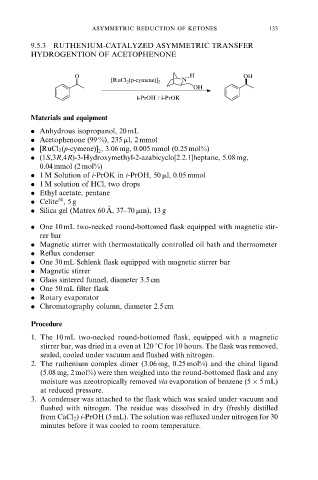
             9.5.3  RUTHENIUM-CATALYZED ASYMMETRIC TRANSFER
             HYDROGENTION OF ACETOPHENONE


                         O                              H             OH
                                   [RuCl 2 (p-cymene)] 2  N
                                                         OH
                                          i-PrOH / i-PrOK


             Materials and equipment
             . Anhydrous isopropanol, 20 mL
             . Acetophenone (99 %), 235 ml, 2 mmol
             . [RuCl 2 (p-cymene)] , 3.06 mg, 0.005 mmol (0.25 mol%)
                               2
             . (1S,3R,4R)-3-Hydroxymethyl-2-azabicyclo[2.2.1]heptane, 5.08 mg,
               0.04 mmol (2 mol%)
             . 1 M Solution of i-PrOK in i-PrOH, 50 ml, 0.05 mmol
             . 1 M solution of HCl, two drops
             . Ethyl acetate, pentane
                    1
             . Celite , 5 g
                                  Ê
             . Silica gel (Matrex 60 A, 37±70 mm), 13 g
             . One 10 mL two-necked round-bottomed flask equipped with magnetic stir-
               rer bar
             . Magnetic stirrer with thermostatically controlled oil bath and thermometer
             . Reflux condenser
             . One 30 mL Schlenk flask equipped with magnetic stirrer bar
             . Magnetic stirrer
             . Glass sintered funnel, diameter 3.5 cm
             . One 50 mL filter flask
             . Rotary evaporator
             . Chromatography column, diameter 2.5 cm

             Procedure

             1. The 10 mL two-necked round-bottomed flask, equipped with a magnetic
               stirrer bar, was dried in a oven at 120 8C for 10 hours. The flask was removed,
               sealed, cooled under vacuum and flushed with nitrogen.
             2. The ruthenium complex dimer (3.06 mg, 0.25 mol%) and the chiral ligand
               (5.08 mg, 2 mol%) were then weighed into the round-bottomed flask and any
               moisture was azeotropically removed via evaporation of benzene (5   5 mL)
               at reduced pressure.
             3. A condenser was attached to the flask which was sealed under vacuum and
               flushed with nitrogen. The residue was dissolved in dry (freshly distilled
               from CaCl 2 ) i-PrOH (5 mL). The solution was refluxed under nitrogen for 30
               minutes before it was cooled to room temperature.

