


Page 147 - Catalysts for Fine Chemical Synthesis Vol 1 - Robert & Poignant
P. 147
134            hydrolysis, oxidation and reduction

               4. Once the clear reddish solution of the catalyst had cooled to room tempera-
                  ture, it was transferred under a gentle stream of nitrogen to a Schlenk flask
                  containing a solution of the ketone (235 mL, 2 mmol) and potassium iso-
                  propoxide (0.05 mmol, 2.5 mol%) in i-PrOH (15 mL). The resulting solution
                  was then stirred for 1.5 hours at room temperature under nitrogen (moni-
                                    1
                  tored by GC and/or H NMR).
               5. After completion, the reaction was neutralized with a 1 M solution of HCl (2
                  drops) and concentrated in vacuo to give the crude product. After dilution
                  with ethyl acetate and removal of the catalyst by filtration over a thin pad of
                  Celite, the sample was analysed.
                    The ee of the alcohol (94 %) was determined by HPLC analysis (ChiralCel
                  OD-H) using a 254 nm UV detector and a flow rate of 0.5 mL/min of 5 % of
                  i-PrOH in hexane. (S)-a-Methylbenzyl alcohol (major): R t 20.65 min; (R)-a-
                  methylbenzyl alcohol (minor): R t 17.72 min.
               6. Finally, the crude product was purified by flash chromatography (eluent:
                  pentane/ethyl acetate: 85/15) to afford 224.5 mg of pure alcohol (92 % yield).

               Conclusion
               The procedure is very easy to reproduce and the asymmetric transfer hydro-
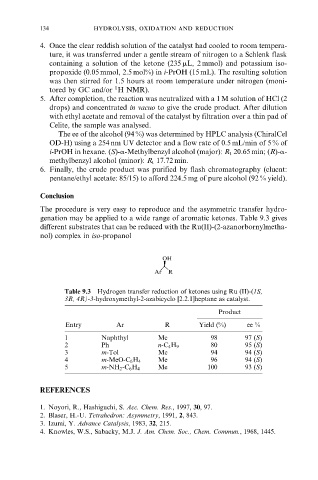
               genation may be applied to a wide range of aromatic ketones. Table 9.3 gives
               different substrates that can be reduced with the Ru(II)-(2-azanorbornylmetha-
               nol) complex in iso-propanol


                                                OH
                                              Ar  R

                      Table 9.3  Hydrogen transfer reduction of ketones using Ru (II)-(1S,
                      3R, 4R)-3-hydroxymethyl-2-azabicyclo [2.2.1]heptane as catalyst.
                                                                Product
                      Entry         Ar           R        Yield (%)    ee %

                      1         Naphthyl       Me             98       97 (S)
                      2         Ph             n-C 4 H 9      80       95 (S)
                      3         m-Tol          Me             94       94 (S)
                      4         m-MeO-C 6 H 4  Me             96       94 (S)
                      5         m-NH 2 -C 6 H 4  Me          100       93 (S)


               REFERENCES
               1. Noyori, R., Hashiguchi, S. Acc. Chem. Res., 1997, 30, 97.
               2. Blaser, H.-U. Tetrahedron: Asymmetry, 1991, 2, 843.
               3. Izumi, Y. Advance Catalysis, 1983, 32, 215.
               4. Knowles, W.S., Sabacky, M.J. J. Am. Chem. Soc., Chem. Commun., 1968, 1445.

