


Page 280 - Challenges in Corrosion Costs Causes Consequences and Control(2015)
P. 280
258                                 CORROSION CONTROL AND PREVENTION

           permanent underground storage. The most common materials of construction of stor-
           age containers are steel and concrete. The wall thickness of the packaging is generally
           thick in comparison to the contained volume.
              Corrosion is a form of material degradation that results when moisture or water
           comes into contact with the packaging materials. A corrosion failure may not result
           in a large release of nuclear waste and radiation; however, a leak would be considered
           potentially hazardous and therefore unacceptable. At present, nuclear waste is stored
           at temporary locations, including water basins in nuclear power plants and at dry
           locations aboveground. Deep underground storage in Yucca Mountain, Nevada, has
           been proposed as a permanent storage solution.
              The vast majority of nuclear shipments are very small in size (0.45 kg or 1 lb) and
           total 2.8 million shipments per year. Spent fuel shipments weigh 0.5–1.0 metric tons
           for truck shipments and up to 10 metric tons for rail shipments. In addition, protective
           lead shipping casks for containment of the spent fuel weigh many more additional
           tons. Corrosion is not a problem in the transportation of nuclear waste because of the
           stringent package requirements and short duration of transport. However, corrosion
           is an important problem in the design of casks used for permanent storage.
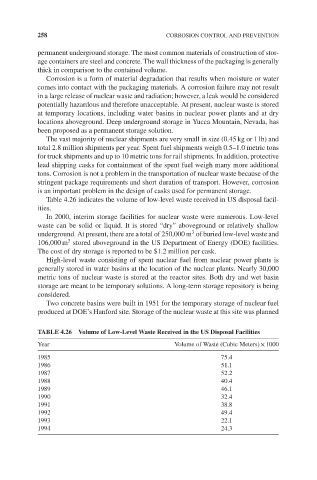
              Table 4.26 indicates the volume of low-level waste received in US disposal facil-
           ities.
              In 2000, interim storage facilities for nuclear waste were numerous. Low-level
           waste can be solid or liquid. It is stored “dry” aboveground or relatively shallow
                                                      3
           underground. At present, there are a total of 250,000 m of buried low-level waste and
                    3
           106,000 m stored aboveground in the US Department of Energy (DOE) facilities.
           The cost of dry storage is reported to be $1.2 million per cask.
              High-level waste consisting of spent nuclear fuel from nuclear power plants is
           generally stored in water basins at the location of the nuclear plants. Nearly 30,000
           metric tons of nuclear waste is stored at the reactor sites. Both dry and wet basin
           storage are meant to be temporary solutions. A long-term storage repository is being
           considered.
              Two concrete basins were built in 1951 for the temporary storage of nuclear fuel
           produced at DOE’s Hanford site. Storage of the nuclear waste at this site was planned

           TABLE 4.26  Volume of Low-Level Waste Received in the US Disposal Facilities
           Year                                  Volume of Waste (Cubic Meters) × 1000

           1985                                               75.4
           1986                                               51.1
           1987                                               52.2
           1988                                               40.4
           1989                                               46.1
           1990                                               32.4
           1991                                               38.8
           1992                                               49.4
           1993                                               22.1
           1994                                               24.3

