


Page 183 - Chemical and process design handbook
P. 183
Speight_Part II_C  11/7/01  3:08 PM  Page 2.124


                          CALCIUM CARBONATE


                  Calcium carbonate (CaCO ) occurs naturally as calcite (density: 2.7), a
                                          3
                  widely distributed mineral. Calcite is a common constituent of sedimen-
                  tary rocks, as a vein mineral, and as deposits from hot springs and in caves
                  as stalactites and stalagmites. Calcite is white or colorless through shades
                  of gray, red, yellow, green, blue, violet, brown, or even black when charged
                  with impurities; streaked, white; transparent to opaque. It may occasion-
                  ally show phosphorescence or fluorescence.
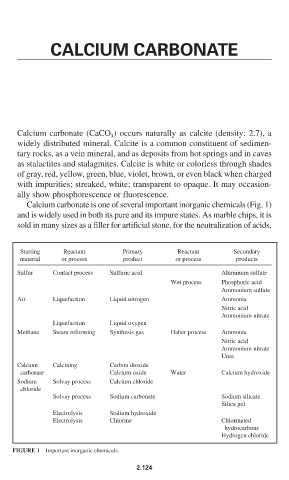
                    Calcium carbonate is one of several important inorganic chemicals (Fig. 1)
                  and is widely used in both its pure and its impure states. As marble chips, it is
                  sold in many sizes as a filler for artificial stone, for the neutralization of acids,


                   Starting   Reactant       Primary       Reactant      Secondary
                   material  or process      product      or process      products

                  Sulfur   Contact process  Sulfuric acid             Aluminum sulfate
                                                         Wet process  Phosphoric acid
                                                                      Ammonium sulfate
                  Air      Liquefaction   Liquid nitrogen             Ammonia
                                                                      Nitric acid
                                                                      Ammonium nitrate
                           Liquefaction   Liquid oxygen
                  Methane  Steam reforming  Synthesis gas  Haber process  Ammonia
                                                                      Nitric acid
                                                                      Ammonium nitrate
                                                                      Urea
                  Calcium   Calcining     Carbon dioxide
                   carbonate              Calcium oxide  Water        Calcium hydroxide
                  Sodium   Solvay process  Calcium chloride
                   chloride
                           Solvay process  Sodium carbonate           Sodium silicate
                                                                      Silica gel
                           Electrolysis   Sodium hydroxide
                           Electrolysis   Chlorine                    Chlorinated
                                                                       hydrocarbons
                                                                      Hydrogen chloride

                 FIGURE 1  Important inorganic chemicals.

                                                2.124

