


Page 191 - Chemical and process design handbook
P. 191
Speight_Part II_C  11/7/01  3:08 PM  Page 2.132


                  2.132                 MANUFACTURE OF CHEMICALS


                    limestone        limestone


                               1
                                      CO
                                        2


                   coke                  coke

                               2


                               3
                  air                      air


                              CaO
                        1. preheating section
                        2. reaction zone
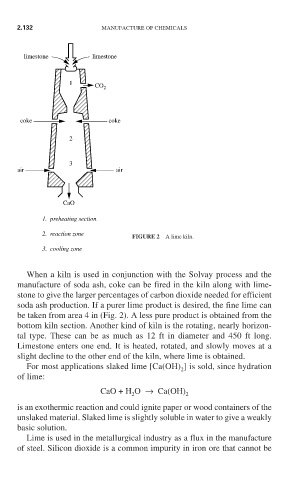
                                               FIGURE 2  A lime kiln.
                        3. cooling zone


                    When a kiln is used in conjunction with the Solvay process and the
                  manufacture of soda ash, coke can be fired in the kiln along with lime-
                  stone to give the larger percentages of carbon dioxide needed for efficient
                  soda ash production. If a purer lime product is desired, the fine lime can
                  be taken from area 4 in (Fig. 2). A less pure product is obtained from the
                  bottom kiln section. Another kind of kiln is the rotating, nearly horizon-
                  tal type. These can be as much as 12 ft in diameter and 450 ft long.
                  Limestone enters one end. It is heated, rotated, and slowly moves at a
                  slight decline to the other end of the kiln, where lime is obtained.
                    For most applications slaked lime [Ca(OH) ] is sold, since hydration
                                                            2
                  of lime:
                                       CaO + H O  → Ca(OH)
                                               2             2
                  is an exothermic reaction and could ignite paper or wood containers of the
                  unslaked material. Slaked lime is slightly soluble in water to give a weakly
                  basic solution.
                    Lime is used in the metallurgical industry as a flux in the manufacture
                  of steel. Silicon dioxide is a common impurity in iron ore that cannot be

