


Page 324 - Compression Machinery for Oil and Gas
P. 324
310 SECTION    II Types of Equipment


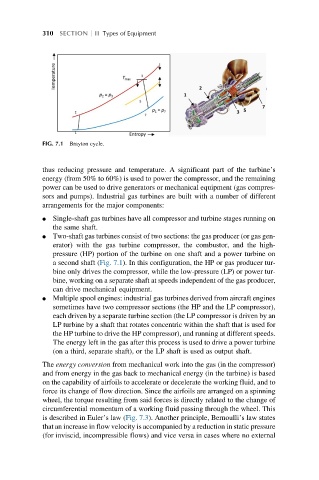
            FIG. 7.1 Brayton cycle.


            thus reducing pressure and temperature. A significant part of the turbine’s
            energy (from 50% to 60%) is used to power the compressor, and the remaining
            power can be used to drive generators or mechanical equipment (gas compres-
            sors and pumps). Industrial gas turbines are built with a number of different
            arrangements for the major components:
            l Single-shaft gas turbines have all compressor and turbine stages running on
               the same shaft.
            l Two-shaft gas turbines consist of two sections: the gas producer (or gas gen-
               erator) with the gas turbine compressor, the combustor, and the high-
               pressure (HP) portion of the turbine on one shaft and a power turbine on
               a second shaft (Fig. 7.1). In this configuration, the HP or gas producer tur-
               bine only drives the compressor, while the low-pressure (LP) or power tur-
               bine, working on a separate shaft at speeds independent of the gas producer,
               can drive mechanical equipment.
            l Multiple spool engines: industrial gas turbines derived from aircraft engines
               sometimes have two compressor sections (the HP and the LP compressor),
               each driven by a separate turbine section (the LP compressor is driven by an
               LP turbine by a shaft that rotates concentric within the shaft that is used for
               the HP turbine to drive the HP compressor), and running at different speeds.
               The energy left in the gas after this process is used to drive a power turbine
               (on a third, separate shaft), or the LP shaft is used as output shaft.
            The energy conversion from mechanical work into the gas (in the compressor)
            and from energy in the gas back to mechanical energy (in the turbine) is based
            on the capability of airfoils to accelerate or decelerate the working fluid, and to
            force its change of flow direction. Since the airfoils are arranged on a spinning
            wheel, the torque resulting from said forces is directly related to the change of
            circumferential momentum of a working fluid passing through the wheel. This
            is described in Euler’s law (Fig. 7.3). Another principle, Bernoulli’s law states
            that an increase in flow velocity is accompanied by a reduction in static pressure
            (for inviscid, incompressible flows) and vice versa in cases where no external

