


Page 150 - Computational Fluid Dynamics for Engineers
P. 150
136               4.  Numerical  Methods  for  Model  Parabolic  and  Elliptic  Equations


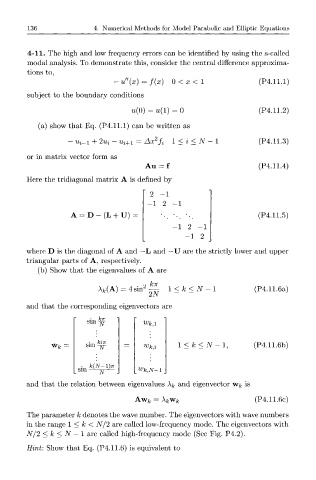
         4-11.  The  high  and  low  frequency  errors  can  be  identified  by  using  the  s-called
         modal  analysis.  To demonstrate  this,  consider  the  central  difference  approxima-
         tions  to,
                                 -  u"{x)  =  f{x)  0  <  x  <  1        (P4.11.1)
         subject  to  the  boundary  conditions

                                      u(0)  =  i/(l)  =  0               (P4.11.2)

            (a)  show that  Eq.  (P4.11.1)  can  be  written  as
                                             2
                    —  Ui-i  -f  2ui  — iij+i  =  Ax fi  1 <  i  <  N  —  1  (P4.11.3)
         or  in  matrix  vector  form  as
                                         Au  =  f                        (P4.11.4)

         Here  the  tridiagonal  matrix  A  is  defined  by
                                           2  - 1
                                          - 1  2  - 1
                     A  =  D  -  (L  -f  U)                              (P4.11.5)
                                                 - 1  2  - 1
                                                     - 1  2
        where  D  is the  diagonal  of  A  and  — L  and  — U  are the  strictly  lower  and  upper
        triangular  parts  of A,  respectively.
            (b)  Show that  the  eigenvalues  of  A  are

                                           kn
                            Afc(A)  =  4 sin'   Kk<     N  - 1          (P4.11.6a)
                                          2N
        and  that  the  corresponding  eigenvectors  are
                            /C7T
                         sin   N         Wfc,l

                            km
               Wjfe      sin  N          Wk,i      1 <  k<  i V - 1 ,   (P4.11.6b)

                          fc(JV-l)7T
                       sin   N
        and  that  the  relation  between  eigenvalues  A& and  eigenvector  w&  is

                                            =                           (P4.11.6c)
                                       Aw fe  X kw k
        The parameter  k denotes the wave number. The eigenvectors with wave  numbers
        in the  range  1 <  k  <  N/2  are  called  low-frequency  mode. The  eigenvectors  with
        N/2  <  k  <  N  —  1 are  called  high-frequency  mode  (See  Fig.  P4.2).
         Hint:  Show that  Eq.  (P4.11.6)  is equivalent  to

