


Page 164 -
P. 164
4.3 / ELEMENTS OF CACHE DESIGN 135

                      1.0
                      0.9
                      0.8
                      0.7
                     Hit ratio  0.6
                      0.5
                      0.4
                      0.3
                      0.2
                      0.1
                      0.0
                           1k   2k   4k   8k   16k  32k  64k  128k  256k  512k  1M
                                               Cache size (bytes)
                            Direct
                            2-way
                            4-way
                            8-way
                            16-way
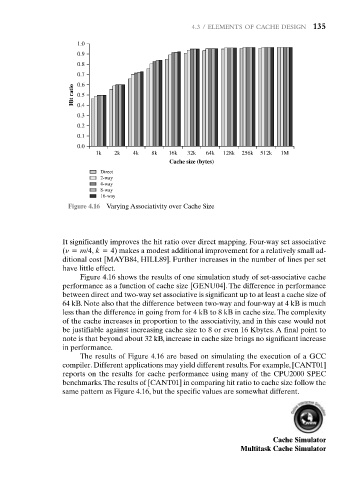
                    Figure 4.16 Varying Associativity over Cache Size


                  It significantly improves the hit ratio over direct mapping. Four-way set associative
                  (n = m/4, k = 4 ) makes a modest additional improvement for a relatively small ad-
                  ditional cost [MAYB84, HILL89]. Further increases in the number of lines per set
                  have little effect.
                       Figure 4.16 shows the results of one simulation study of set-associative cache
                  performance as a function of cache size [GENU04]. The difference in performance
                  between direct and two-way set associative is significant up to at least a cache size of
                  64 kB. Note also that the difference between two-way and four-way at 4 kB is much
                  less than the difference in going from for 4 kB to 8 kB in cache size.The complexity
                  of the cache increases in proportion to the associativity, and in this case would not
                  be justifiable against increasing cache size to 8 or even 16 Kbytes. A final point to
                  note is that beyond about 32 kB, increase in cache size brings no significant increase
                  in performance.
                       The results of Figure 4.16 are based on simulating the execution of a GCC
                  compiler. Different applications may yield different results. For example, [CANT01]
                  reports on the results for cache performance using many of the CPU2000 SPEC
                  benchmarks.The results of [CANT01] in comparing hit ratio to cache size follow the
                  same pattern as Figure 4.16, but the specific values are somewhat different.


                                                                            Cache Simulator
                                                                   Multitask Cache Simulator

