


Page 159 -
P. 159
130  CHAPTER 4 / CACHE MEMORY


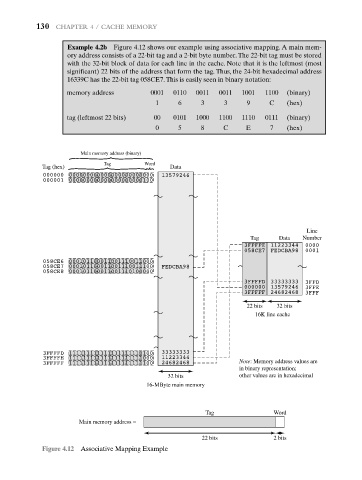
                   Example 4.2b  Figure 4.12 shows our example using associative mapping. A main mem-
                   ory address consists of a 22-bit tag and a 2-bit byte number.The 22-bit tag must be stored
                   with the 32-bit block of data for each line in the cache. Note that it is the leftmost (most
                   significant) 22 bits of the address that form the tag. Thus, the 24-bit hexadecimal address
                   16339C has the 22-bit tag 058CE7.This is easily seen in binary notation:

                   memory address         0001  0110   0011  0011  1001  1100  (binary)
                                            1     6     3     3     9      C   (hex)

                   tag (leftmost 22 bits)  00   0101   1000  1100  1110  0111  (binary)
                                            0     5     8     C     E      7   (hex)


                       Main memory address (binary)
                             Tag        Word
             Tag (hex)                         Data
             000000  000000000000000000000000  13579246
             000001  000000000000000000000100


                                                                                     Line
                                                                     Tag     Data   Number
                                                                    3FFFFE  11223344  0000
                                                                    058CE7 FEDCBA98  0001
             058CE6  000101100011001110011000
             058CE7  000101100011001110011100  FEDCBA98
             058CE8  000101100011001110100000
                                                                    3FFFFD 33333333  3FFD
                                                                    000000 13579246  3FFE
                                                                    3FFFFF 24682468  3FFF
                                                                    22 bits  32 bits
                                                                       16K line cache


             3FFFFD  111111111111111111110100  33333333
             3FFFFE  111111111111111111111000  11223344
             3FFFFF  111111111111111111111100  24682468           Note: Memory address values are
                                                                  in binary representation;
                                               32 bits            other values are in hexadecimal
                                         16-MByte main memory


                                                         Tag                Word
                       Main memory address =
                                                        22 bits             2 bits
             Figure 4.12 Associative Mapping Example

