


Page 158 -
P. 158
4.3 / ELEMENTS OF CACHE DESIGN 129

                                s+w


                                                Cache                       Main memory
                  Memory address             Tag    Data                        W0
                   Tag      Word                                                W1
                                                                                W2      B 0
                                                            L
             s                                                0                 W3
                             w


                                     w                      L
                                                             j
                                                                          s
                                                                                W4j
              Compare                                                     w   W(4j+1)   B
                                                                              W(4j+2)    j
                                                                              W(4j+3)
                            (Hit in cache)
                 1 if match
                 0 if no match   s
                                                            L m–1
                0 if match
                1 if no match
                         (Miss in cache)
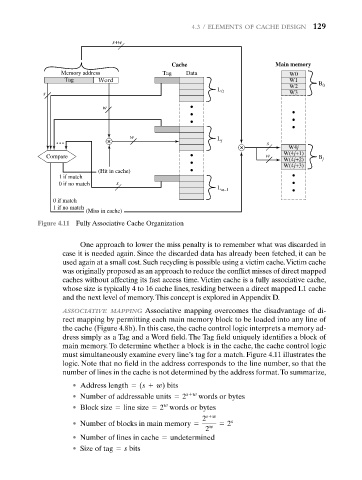
           Figure 4.11 Fully Associative Cache Organization

                       One approach to lower the miss penalty is to remember what was discarded in
                  case it is needed again. Since the discarded data has already been fetched, it can be
                  used again at a small cost. Such recycling is possible using a victim cache.Victim cache
                  was originally proposed as an approach to reduce the conflict misses of direct mapped
                  caches without affecting its fast access time. Victim cache is a fully associative cache,
                  whose size is typically 4 to 16 cache lines, residing between a direct mapped L1 cache
                  and the next level of memory.This concept is explored in Appendix D.

                  ASSOCIATIVE MAPPING Associative mapping overcomes the disadvantage of di-
                  rect mapping by permitting each main memory block to be loaded into any line of
                  the cache (Figure 4.8b). In this case, the cache control logic interprets a memory ad-
                  dress simply as a Tag and a Word field. The Tag field uniquely identifies a block of
                  main memory. To determine whether a block is in the cache, the cache control logic
                  must simultaneously examine every line’s tag for a match. Figure 4.11 illustrates the
                  logic. Note that no field in the address corresponds to the line number, so that the
                  number of lines in the cache is not determined by the address format.To summarize,
                     • Address length =  (s +  w) bits
                     • Number of addressable units =  2 s w  words or bytes
                     • Block size =  line size =  2 words or bytes
                                              w
                                                        2 s+w
                     • Number of blocks in main memory =     = 2 s
                                                         2 w
                     • Number of lines in cache =  undetermined
                     • Size of tag =  s bits

