


Page 190 -
P. 190
160  CHAPTER 5 / INTERNAL MEMORY

                                     Control                     Control


                              Select          Data in     Select          Sense
                                      Cell                        Cell

                                     (a) Write                   (b) Read
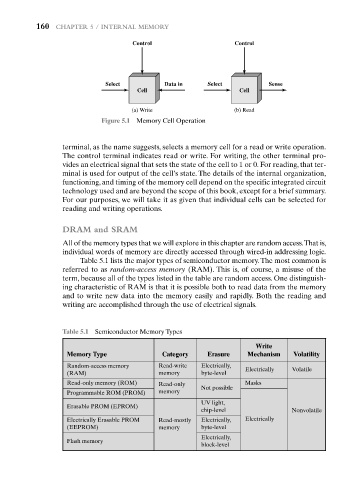
                             Figure 5.1 Memory Cell Operation


                  terminal, as the name suggests, selects a memory cell for a read or write operation.
                  The control terminal indicates read or write. For writing, the other terminal pro-
                  vides an electrical signal that sets the state of the cell to 1 or 0. For reading, that ter-
                  minal is used for output of the cell’s state. The details of the internal organization,
                  functioning, and timing of the memory cell depend on the specific integrated circuit
                  technology used and are beyond the scope of this book, except for a brief summary.
                  For our purposes, we will take it as given that individual cells can be selected for
                  reading and writing operations.


                  DRAM and SRAM
                  All of the memory types that we will explore in this chapter are random access.That is,
                  individual words of memory are directly accessed through wired-in addressing logic.
                       Table 5.1 lists the major types of semiconductor memory.The most common is
                  referred to as random-access memory (RAM). This is, of course, a misuse of the
                  term, because all of the types listed in the table are random access. One distinguish-
                  ing characteristic of RAM is that it is possible both to read data from the memory
                  and to write new data into the memory easily and rapidly. Both the reading and
                  writing are accomplished through the use of electrical signals.


                  Table 5.1 Semiconductor Memory Types

                                                                       Write
                   Memory Type               Category     Erasure    Mechanism   Volatility
                   Random-access memory     Read-write   Electrically,
                                                                    Electrically  Volatile
                   (RAM)                    memory      byte-level
                   Read-only memory (ROM)   Read-only               Masks
                   Programmable ROM (PROM)  memory      Not possible
                                                        UV light,
                   Erasable PROM (EPROM)
                                                        chip-level               Nonvolatile
                   Electrically Erasable PROM  Read-mostly   Electrically,  Electrically
                   (EEPROM)                 memory      byte-level
                                                        Electrically,
                   Flash memory
                                                        block-level

