


Page 191 -
P. 191
5.1 / SEMICONDUCTOR MAIN MEMORY 161

                       The other distinguishing characteristic of RAM is that it is volatile. A RAM
                  must be provided with a constant power supply. If the power is interrupted, then the
                  data are lost.Thus, RAM can be used only as temporary storage.The two traditional
                  forms of RAM used in computers are DRAM and SRAM.
                  DYNAMIC RAM RAM technology is divided into two technologies: dynamic and
                  static. A dynamic RAM (DRAM) is made with cells that store data as charge on
                  capacitors. The presence or absence of charge in a capacitor is interpreted as a bi-
                  nary 1 or 0. Because capacitors have a natural tendency to discharge, dynamic
                  RAMs require periodic charge refreshing to maintain data storage. The term
                  dynamic refers to this tendency of the stored charge to leak away, even with power
                  continuously applied.
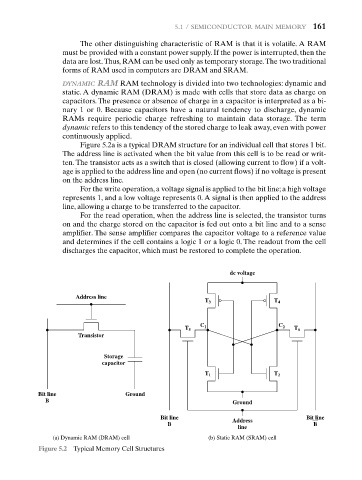
                       Figure 5.2a is a typical DRAM structure for an individual cell that stores 1 bit.
                  The address line is activated when the bit value from this cell is to be read or writ-
                  ten. The transistor acts as a switch that is closed (allowing current to flow) if a volt-
                  age is applied to the address line and open (no current flows) if no voltage is present
                  on the address line.
                       For the write operation, a voltage signal is applied to the bit line; a high voltage
                  represents 1, and a low voltage represents 0. A signal is then applied to the address
                  line, allowing a charge to be transferred to the capacitor.
                       For the read operation, when the address line is selected, the transistor turns
                  on and the charge stored on the capacitor is fed out onto a bit line and to a sense
                  amplifier. The sense amplifier compares the capacitor voltage to a reference value
                  and determines if the cell contains a logic 1 or a logic 0. The readout from the cell
                  discharges the capacitor, which must be restored to complete the operation.


                                                                dc voltage


                      Address line
                                                         T 3                T 4


                                                        C 1                  C 2
                                                    T 5                          T 6
                      Transistor
                             Storage
                             capacitor
                                                         T 1                T 2

           Bit line                Ground
             B                                                   Ground

                                             Bit line                                Bit line
                                                                Address
                                               B                                       B
                                                                  line
               (a) Dynamic RAM (DRAM) cell                (b) Static RAM (SRAM) cell
            Figure 5.2 Typical Memory Cell Structures

