


Page 230 -
P. 230
6.2 / RAID 197


             strip 0   strip 1   strip 2    strip 3
             strip 4   strip 5   strip 6    strip 7
             strip 8   strip 9   strip 10  strip 11
             strip 12  strip 13  strip 14  strip 15


            (a) RAID 0 (Nonredundant)


             strip 0   strip 1   strip 2    strip 3   strip 0   strip 1   strip 2   strip 3
             strip 4   strip 5   strip 6    strip 7   strip 4   strip 5   strip 6   strip 7
             strip 8   strip 9   strip 10  strip 11   strip 8   strip 9   strip 10  strip 11
             strip 12  strip 13  strip 14  strip 15  strip 12  strip 13   strip 14  strip 15


            (b) RAID 1 (Mirrored)


              b 0        b 1       b 2       b 3      f 0 (b)   f 1 (b)   f 2 (b)


            (c) RAID 2 (Redundancy through Hamming code)
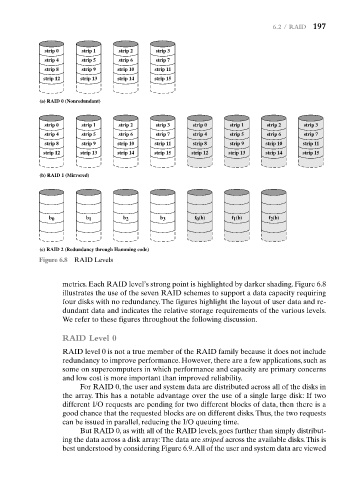
            Figure 6.8 RAID Levels


                  metrics. Each RAID level’s strong point is highlighted by darker shading. Figure 6.8
                  illustrates the use of the seven RAID schemes to support a data capacity requiring
                  four disks with no redundancy. The figures highlight the layout of user data and re-
                  dundant data and indicates the relative storage requirements of the various levels.
                  We refer to these figures throughout the following discussion.

                  RAID Level 0

                  RAID level 0 is not a true member of the RAID family because it does not include
                  redundancy to improve performance. However, there are a few applications, such as
                  some on supercomputers in which performance and capacity are primary concerns
                  and low cost is more important than improved reliability.
                       For RAID 0, the user and system data are distributed across all of the disks in
                  the array. This has a notable advantage over the use of a single large disk: If two
                  different I/O requests are pending for two different blocks of data, then there is a
                  good chance that the requested blocks are on different disks.Thus, the two requests
                  can be issued in parallel, reducing the I/O queuing time.
                       But RAID 0, as with all of the RAID levels, goes further than simply distribut-
                  ing the data across a disk array:The data are striped across the available disks.This is
                  best understood by considering Figure 6.9.All of the user and system data are viewed

