


Page 232 -
P. 232
6.2 / RAID 199

                                    Physical        Physical       Physical       Physical
            Logical disk             disk 0         disk 1          disk 2         disk 3

              strip 0                strip 0        strip 1        strip 2        strip 3
              strip 1                strip 4        strip 5        strip 6        strip 7
              strip 2                strip 8        strip 9        strip 10       strip 11
              strip 3                strip 12       strip 13       strip 14       strip 15
              strip 4
              strip 5
              strip 6
              strip 7             Array
              strip 8           management
                                 software
              strip 9
              strip 10
              strip 11
              strip 12
              strip 13
              strip 14
              strip 15


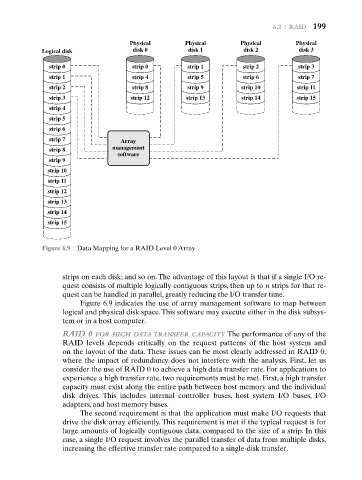
             Figure 6.9 Data Mapping for a RAID Level 0 Array


                  strips on each disk; and so on. The advantage of this layout is that if a single I/O re-
                  quest consists of multiple logically contiguous strips, then up to n strips for that re-
                  quest can be handled in parallel, greatly reducing the I/O transfer time.
                       Figure 6.9 indicates the use of array management software to map between
                  logical and physical disk space.This software may execute either in the disk subsys-
                  tem or in a host computer.

                  RAID 0 FOR HIGH DATA TRANSFER CAPACITY The performance of any of the
                  RAID levels depends critically on the request patterns of the host system and
                  on the layout of the data. These issues can be most clearly addressed in RAID 0,
                  where the impact of redundancy does not interfere with the analysis. First, let us
                  consider the use of RAID 0 to achieve a high data transfer rate. For applications to
                  experience a high transfer rate, two requirements must be met. First, a high transfer
                  capacity must exist along the entire path between host memory and the individual
                  disk drives. This includes internal controller buses, host system I/O buses, I/O
                  adapters, and host memory buses.
                       The second requirement is that the application must make I/O requests that
                  drive the disk array efficiently. This requirement is met if the typical request is for
                  large amounts of logically contiguous data, compared to the size of a strip. In this
                  case, a single I/O request involves the parallel transfer of data from multiple disks,
                  increasing the effective transfer rate compared to a single-disk transfer.

