


Page 237 -
P. 237
204  CHAPTER 6 / EXTERNAL MEMORY

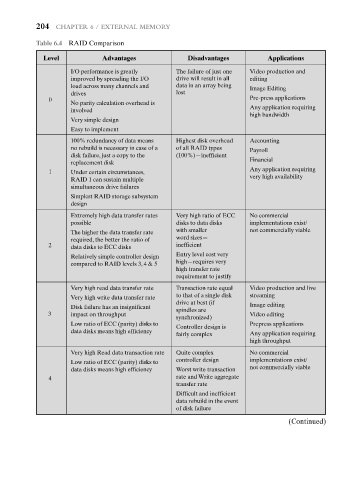
           Table 6.4 RAID Comparison

             Level           Advantages             Disadvantages         Applications
                    I/O performance is greatly   The failure of just one   Video production and
                    improved by spreading the I/O   drive will result in all   editing
                    load across many channels and   data in an array being  Image Editing
                    drives                       lost
              0                                                      Pre-press applications
                    No parity calculation overhead is
                                                                     Any application requiring
                    involved
                                                                     high bandwidth
                    Very simple design
                    Easy to implement
                    100% redundancy of data means   Highest disk overhead   Accounting
                    no rebuild is necessary in case of a   of all RAID types   Payroll
                    disk failure, just a copy to the   (100%)—inefficient
                    replacement disk                                 Financial
              1     Under certain circumstances,                     Any application requiring
                    RAID 1 can sustain multiple                      very high availability
                    simultaneous drive failures
                    Simplest RAID storage subsystem
                    design
                    Extremely high data transfer rates   Very high ratio of ECC   No commercial
                    possible                     disks to data disks   implementations exist/
                    The higher the data transfer rate   with smaller   not commercially viable
                    required, the better the ratio of   word sizes—
              2     data disks to ECC disks      inefficient
                    Relatively simple controller design   Entry level cost very
                    compared to RAID levels 3, 4 & 5  high—requires very
                                                 high transfer rate
                                                 requirement to justify
                    Very high read data transfer rate  Transaction rate equal   Video production and live
                                                 to that of a single disk   streaming
                    Very high write data transfer rate
                                                 drive at best (if
                    Disk failure has an insignificant                Image editing
                                                 spindles are
              3     impact on throughput                             Video editing
                                                 synchronized)
                    Low ratio of ECC (parity) disks to               Prepress applications
                                                 Controller design is
                    data disks means high efficiency
                                                 fairly complex      Any application requiring
                                                                     high throughput
                    Very high Read data transaction rate  Quite complex   No commercial
                    Low ratio of ECC (parity) disks to   controller design  implementations exist/
                    data disks means high efficiency  Worst write transaction   not commercially viable
              4                                  rate and Write aggregate
                                                 transfer rate
                                                 Difficult and inefficient
                                                 data rebuild in the event
                                                 of disk failure

                                                                                (Continued)

