


Page 240 -
P. 240
6.3 / OPTICAL MEMORY 207


                                     MIN  SEC  Sector  Mode                       ECC
                     00  FF ... FF  00                        Data               Layered


                         12 bytes      4 bytes             2048 bytes           288 bytes
                         SYNC            ID                  Data                L-ECC


                                                  2352 bytes


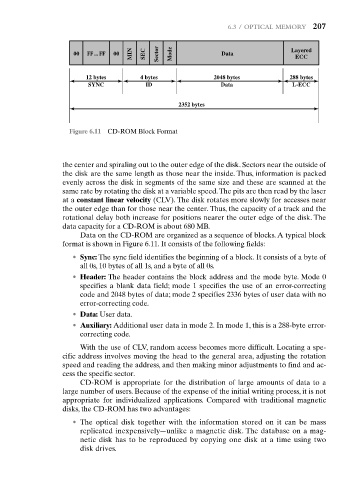
                    Figure 6.11  CD-ROM Block Format


                  the center and spiraling out to the outer edge of the disk. Sectors near the outside of
                  the disk are the same length as those near the inside. Thus, information is packed
                  evenly across the disk in segments of the same size and these are scanned at the
                  same rate by rotating the disk at a variable speed.The pits are then read by the laser
                  at a constant linear velocity (CLV). The disk rotates more slowly for accesses near
                  the outer edge than for those near the center. Thus, the capacity of a track and the
                  rotational delay both increase for positions nearer the outer edge of the disk. The
                  data capacity for a CD-ROM is about 680 MB.
                       Data on the CD-ROM are organized as a sequence of blocks. A typical block
                  format is shown in Figure 6.11. It consists of the following fields:

                     • Sync: The sync field identifies the beginning of a block. It consists of a byte of
                       all 0s, 10 bytes of all 1s, and a byte of all 0s.
                     • Header: The header contains the block address and the mode byte. Mode 0
                       specifies a blank data field; mode 1 specifies the use of an error-correcting
                       code and 2048 bytes of data; mode 2 specifies 2336 bytes of user data with no
                       error-correcting code.
                     • Data: User data.
                     • Auxiliary: Additional user data in mode 2. In mode 1, this is a 288-byte error-
                       correcting code.
                       With the use of CLV, random access becomes more difficult. Locating a spe-
                  cific address involves moving the head to the general area, adjusting the rotation
                  speed and reading the address, and then making minor adjustments to find and ac-
                  cess the specific sector.
                       CD-ROM is appropriate for the distribution of large amounts of data to a
                  large number of users. Because of the expense of the initial writing process, it is not
                  appropriate for individualized applications. Compared with traditional magnetic
                  disks, the CD-ROM has two advantages:

                     • The optical disk together with the information stored on it can be mass
                       replicated inexpensively—unlike a magnetic disk. The database on a mag-
                       netic disk has to be reproduced by copying one disk at a time using two
                       disk drives.

