


Page 238 -
P. 238
6.3 / OPTICAL MEMORY 205

           Table 6.4 Continued

             Level           Advantages              Disadvantages         Applications
                     Highest Read data transaction rate  Most complex   File and application
                     Low ratio of ECC (parity) disks to   controller design  servers
                     data disks means high efficiency  Difficult to rebuild in   Database servers
              5      Good aggregate transfer rate  the event of a disk   Web, e-mail, and
                                                  failure (as compared   news servers
                                                  to RAID level 1)
                                                                       Intranet servers
                                                                       Most versatile RAID level
                     Provides for an extremely high data  More complex   Perfect solution for
                     fault tolerance and can sustain multi-  controller design  mission critical
                     ple simultaneous drive failures                   applications
              6                                   Controller overhead
                                                  to compute parity
                                                  addresses is extremely
                                                  high


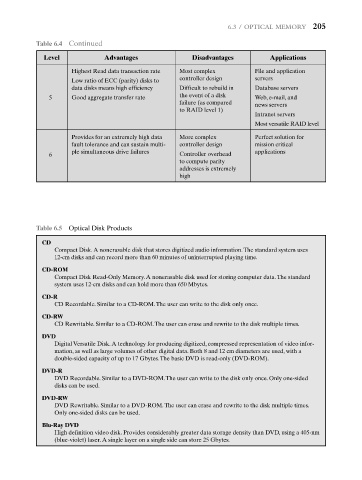
           Table 6.5 Optical Disk Products
             CD
                Compact Disk.A nonerasable disk that stores digitized audio information.The standard system uses
                12-cm disks and can record more than 60 minutes of uninterrupted playing time.
             CD-ROM
                Compact Disk Read-Only Memory.A nonerasable disk used for storing computer data.The standard
                system uses 12-cm disks and can hold more than 650 Mbytes.
             CD-R
                CD Recordable. Similar to a CD-ROM.The user can write to the disk only once.
             CD-RW
                CD Rewritable. Similar to a CD-ROM.The user can erase and rewrite to the disk multiple times.
             DVD
                Digital Versatile Disk.A technology for producing digitized, compressed representation of video infor-
                mation, as well as large volumes of other digital data. Both 8 and 12 cm diameters are used, with a
                double-sided capacity of up to 17 Gbytes.The basic DVD is read-only (DVD-ROM).
             DVD-R
                DVD Recordable. Similar to a DVD-ROM.The user can write to the disk only once. Only one-sided
                disks can be used.
             DVD-RW
                DVD Rewritable. Similar to a DVD-ROM.The user can erase and rewrite to the disk multiple times.
                Only one-sided disks can be used.
             Blu-Ray DVD
                High definition video disk. Provides considerably greater data storage density than DVD, using a 405-nm
                (blue-violet) laser.A single layer on a single side can store 25 Gbytes.

