


Page 243 -
P. 243
210  CHAPTER 6 / EXTERNAL MEMORY

                     2.11 μm
            CD
                                    Data layer
           Beam spot          Land

             Pit                            1.2 μm
                                                               0.58 μm
                                                      Blu-ray
                 Track
                                    Laser wavelength
                                       = 780 nm

                     1.32 μm
            DVD                                                                      0.1 μm


                                                                                  405 nm

                                            0.6 μm


                                        650 nm
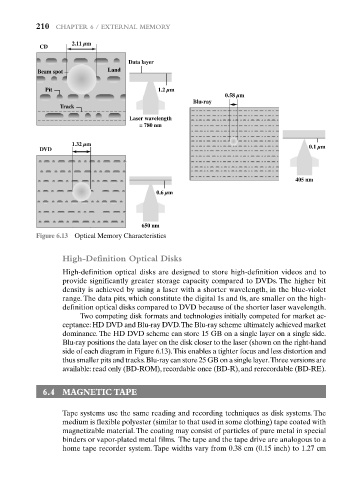
           Figure 6.13 Optical Memory Characteristics


                  High-Definition Optical Disks
                  High-definition optical disks are designed to store high-definition videos and to
                  provide significantly greater storage capacity compared to DVDs. The higher bit
                  density is achieved by using a laser with a shorter wavelength, in the blue-violet
                  range. The data pits, which constitute the digital 1s and 0s, are smaller on the high-
                  definition optical disks compared to DVD because of the shorter laser wavelength.
                       Two competing disk formats and technologies initially competed for market ac-
                  ceptance:HD DVD and Blu-ray DVD.The Blu-ray scheme ultimately achieved market
                  dominance. The HD DVD scheme can store 15 GB on a single layer on a single side.
                  Blu-ray positions the data layer on the disk closer to the laser (shown on the right-hand
                  side of each diagram in Figure 6.13).This enables a tighter focus and less distortion and
                  thus smaller pits and tracks.Blu-ray can store 25 GB on a single layer.Three versions are
                  available: read only (BD-ROM), recordable once (BD-R), and rerecordable (BD-RE).


             6.4 MAGNETIC TAPE


                  Tape systems use the same reading and recording techniques as disk systems. The
                  medium is flexible polyester (similar to that used in some clothing) tape coated with
                  magnetizable material. The coating may consist of particles of pure metal in special
                  binders or vapor-plated metal films. The tape and the tape drive are analogous to a
                  home tape recorder system. Tape widths vary from 0.38 cm (0.15 inch) to 1.27 cm

