


Page 245 -
P. 245
212  CHAPTER 6 / EXTERNAL MEMORY

                  Table 6.6 LTO Tape Drives

                                   LTO-1     LTO-2    LTO-3     LTO-4     LTO-5    LTO-6
                   Release date     2000      2003     2005      2007      TBA      TBA
                   Compressed      200 GB    400 GB   800 GB    1600 GB   3.2 TB   6.4 TB
                   capacity
                   Compressed
                   transfer rate     40        80       160       240       360     540
                   (MB/s)
                   Linear density
                   (bits/mm)        4880      7398     9638      13300
                   Tape tracks       384      512       704       896
                   Tape length      609 m    609 m     680 m     820 m
                   Tape width (cm)  1.27      1.27      1.27     1.27
                   Write elements    8         8        16        16


                  read-write head is capable of reading and writing a number of adjacent tracks
                  simultaneously (typically two to eight tracks). Data are still recorded serially along
                  individual tracks, but blocks in sequence are stored on adjacent tracks, as suggested
                  by Figure 6.14b.
                       A tape drive is a sequential-access device. If the tape head is positioned at
                  record 1,then to read record N, it is necessary to read physical records 1 through N -  1,
                  one at a time. If the head is currently positioned beyond the desired record, it is nec-
                  essary to rewind the tape a certain distance and begin reading forward. Unlike the
                  disk, the tape is in motion only during a read or write operation.
                       In contrast to the tape, the disk drive is referred to as a direct-access device.A
                  disk drive need not read all the sectors on a disk sequentially to get to the desired
                  one. It must only wait for the intervening sectors within one track and can make suc-
                  cessive accesses to any track.
                       Magnetic tape was the first kind of secondary memory. It is still widely used as
                  the lowest-cost, slowest-speed member of the memory hierarchy.
                       The dominant tape technology today is a cartridge system known as linear
                  tape-open (LTO). LTO was developed in the late 1990s as an open-source alterna-
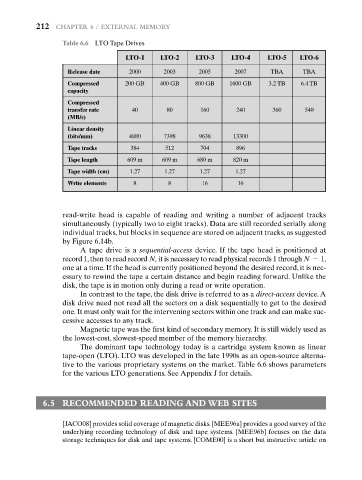
                  tive to the various proprietary systems on the market. Table 6.6 shows parameters
                  for the various LTO generations. See Appendix J for details.


             6.5 RECOMMENDED READING AND WEB SITES


                  [JACO08] provides solid coverage of magnetic disks. [MEE96a] provides a good survey of the
                  underlying recording technology of disk and tape systems. [MEE96b] focuses on the data
                  storage techniques for disk and tape systems. [COME00] is a short but instructive article on

