


Page 244 -
P. 244
6.4 / MAGNETIC TAPE 211

                  (0.5 inch).Tapes used to be packaged as open reels that have to be threaded through
                  a second spindle for use.Today, virtually all tapes are housed in cartridges.
                       Data on the tape are structured as a number of parallel tracks running
                  lengthwise. Earlier tape systems typically used nine tracks.This made it possible to
                  store data one byte at a time, with an additional parity bit as the ninth track. This
                  was followed by tape systems using 18 or 36 tracks, corresponding to a digital word
                  or double word.The recording of data in this form is referred to as parallel record-
                  ing. Most modern systems instead use serial recording, in which data are laid out
                  as a sequence of bits along each track, as is done with magnetic disks. As with the
                  disk, data are read and written in contiguous blocks, called physical records, on a
                  tape. Blocks on the tape are separated by gaps referred to as interrecord gaps. As
                  with the disk, the tape is formatted to assist in locating physical records.
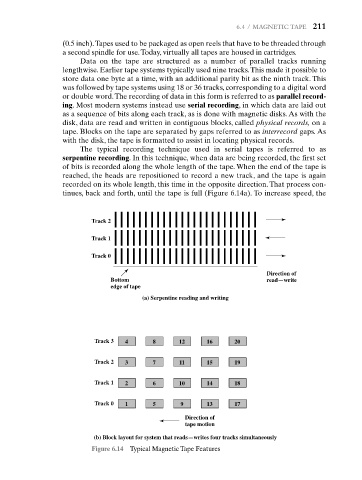
                       The typical recording technique used in serial tapes is referred to as
                  serpentine recording. In this technique, when data are being recorded, the first set
                  of bits is recorded along the whole length of the tape. When the end of the tape is
                  reached, the heads are repositioned to record a new track, and the tape is again
                  recorded on its whole length, this time in the opposite direction. That process con-
                  tinues, back and forth, until the tape is full (Figure 6.14a). To increase speed, the


                          Track 2

                          Track 1

                          Track 0

                                                                          Direction of
                               Bottom                                     read—write
                               edge of tape
                                        (a) Serpentine reading and writing


                           Track 3  4      8      12      16     20


                           Track 2  3      7      11      15     19

                           Track 1  2      6      10      14     18

                           Track 0  1      5      9       13     17

                                                    Direction of
                                                    tape motion
                           (b) Block layout for system that reads—writes four tracks simultaneously
                          Figure 6.14  Typical Magnetic Tape Features

