


Page 239 -
P. 239
206  CHAPTER 6 / EXTERNAL MEMORY

                      Protective
                      acrylic        Label


                                                                  Land
                                                                         Pit
                          Polycarbonate                                       Aluminum
                          plastic


                                                Laser transmit/
                                                   receive
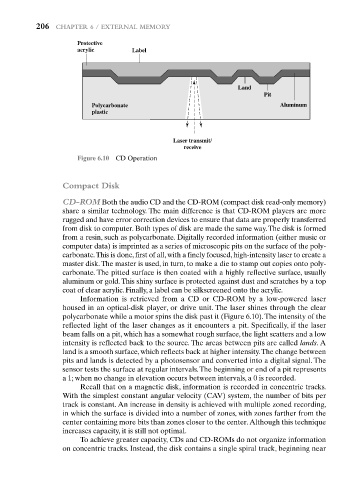
                      Figure 6.10  CD Operation


                  Compact Disk

                  CD-ROM Both the audio CD and the CD-ROM (compact disk read-only memory)
                  share a similar technology. The main difference is that CD-ROM players are more
                  rugged and have error correction devices to ensure that data are properly transferred
                  from disk to computer. Both types of disk are made the same way.The disk is formed
                  from a resin, such as polycarbonate. Digitally recorded information (either music or
                  computer data) is imprinted as a series of microscopic pits on the surface of the poly-
                  carbonate.This is done,first of all,with a finely focused,high-intensity laser to create a
                  master disk.The master is used, in turn, to make a die to stamp out copies onto poly-
                  carbonate. The pitted surface is then coated with a highly reflective surface, usually
                  aluminum or gold. This shiny surface is protected against dust and scratches by a top
                  coat of clear acrylic. Finally, a label can be silkscreened onto the acrylic.
                       Information is retrieved from a CD or CD-ROM by a low-powered laser
                  housed in an optical-disk player, or drive unit. The laser shines through the clear
                  polycarbonate while a motor spins the disk past it (Figure 6.10).The intensity of the
                  reflected light of the laser changes as it encounters a pit. Specifically, if the laser
                  beam falls on a pit, which has a somewhat rough surface, the light scatters and a low
                  intensity is reflected back to the source. The areas between pits are called lands.A
                  land is a smooth surface, which reflects back at higher intensity.The change between
                  pits and lands is detected by a photosensor and converted into a digital signal. The
                  sensor tests the surface at regular intervals.The beginning or end of a pit represents
                  a 1; when no change in elevation occurs between intervals, a 0 is recorded.
                       Recall that on a magnetic disk, information is recorded in concentric tracks.
                  With the simplest constant angular velocity (CAV) system, the number of bits per
                  track is constant. An increase in density is achieved with multiple zoned recording,
                  in which the surface is divided into a number of zones, with zones farther from the
                  center containing more bits than zones closer to the center.Although this technique
                  increases capacity, it is still not optimal.
                       To achieve greater capacity, CDs and CD-ROMs do not organize information
                  on concentric tracks. Instead, the disk contains a single spiral track, beginning near

