


Page 242 -
P. 242
6.3 / OPTICAL MEMORY 209

                      Label

                    Protective layer
                    (acrylic)
                                                                                  1.2 mm
                    Reflective layer                                               thick
                    (aluminum)
                    Polycarbonate substrate                 Laser focuses on polycarbonate
                    (plastic)                               pits in front of reflective layer.


                                                  (a) CD-ROM–Capacity 682 MB

                    Polycarbonate substrate, side 2
                    Semireflective layer, side 2
                    Polycarbonate layer, side 2

                    Fully reflective layer, side 2
                    Fully reflective layer, side 1                                1.2 mm
                                                                                   thick
                    Polycarbonate layer, side 1
                    Semireflective layer, side 1            Laser focuses on pits in one layer
                                                            on one side at a time. Disk must
                    Polycarbonate substrate, side 1         be flipped to read other side.


                                                 (b) DVD-ROM, double-sided, dual-layer–Capacity 17 GB
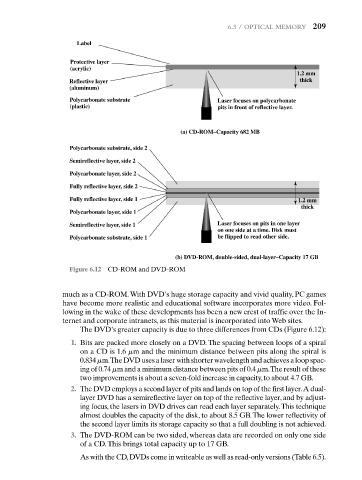
                    Figure 6.12 CD-ROM and DVD-ROM


                  much as a CD-ROM.With DVD’s huge storage capacity and vivid quality, PC games
                  have become more realistic and educational software incorporates more video. Fol-
                  lowing in the wake of these developments has been a new crest of traffic over the In-
                  ternet and corporate intranets, as this material is incorporated into Web sites.
                       The DVD’s greater capacity is due to three differences from CDs (Figure 6.12):
                    1. Bits are packed more closely on a DVD. The spacing between loops of a spiral
                       on a CD is 1.6  m and the minimum distance between pits along the spiral ism
                       0.834 m.The DVD uses a laser with shorter wavelength and achieves a loop spac-m
                       ing of 0.74 m and a minimum distance between pits of 0.4 m.The result of thesemm
                       two improvements is about a seven-fold increase in capacity,to about 4.7 GB.
                    2. The DVD employs a second layer of pits and lands on top of the first layer.A dual-
                       layer DVD has a semireflective layer on top of the reflective layer, and by adjust-
                       ing focus, the lasers in DVD drives can read each layer separately.This technique
                       almost doubles the capacity of the disk, to about 8.5 GB.The lower reflectivity of
                       the second layer limits its storage capacity so that a full doubling is not achieved.
                    3. The DVD-ROM can be two sided, whereas data are recorded on only one side
                       of a CD.This brings total capacity up to 17 GB.

                       As with the CD,DVDs come in writeable as well as read-only versions (Table 6.5).

