


Page 235 -
P. 235
202  CHAPTER 6 / EXTERNAL MEMORY

                  Thus, the contents of each strip of data on X1 can be regenerated from the contents
                  of the corresponding strips on the remaining disks in the array.This principle is true
                  for RAID levels 3 through 6.
                       In the event of a disk failure, all of the data are still available in what is re-
                  ferred to as reduced mode. In this mode, for reads, the missing data are regenerated
                  on the fly using the exclusive-OR calculation. When data are written to a reduced
                  RAID 3 array, consistency of the parity must be maintained for later regeneration.
                  Return to full operation requires that the failed disk be replaced and the entire con-
                  tents of the failed disk be regenerated on the new disk.

                  PERFORMANCE Because data are striped in very small strips, RAID 3 can achieve
                  very high data transfer rates. Any I/O request will involve the parallel transfer of
                  data from all of the data disks. For large transfers, the performance improvement is
                  especially noticeable. On the other hand, only one I/O request can be executed at a
                  time.Thus, in a transaction-oriented environment, performance suffers.

                  RAID Level 4
                  RAID levels 4 through 6 make use of an independent access technique. In an inde-
                  pendent access array, each member disk operates independently, so that separate
                  I/O requests can be satisfied in parallel. Because of this, independent access arrays
                  are more suitable for applications that require high I/O request rates and are rela-
                  tively less suited for applications that require high data transfer rates.
                       As in the other RAID schemes, data striping is used. In the case of RAID 4
                  through 6, the strips are relatively large.With RAID 4, a bit-by-bit parity strip is cal-
                  culated across corresponding strips on each data disk, and the parity bits are stored
                  in the corresponding strip on the parity disk.
                       RAID 4 involves a write penalty when an I/O write request of small size is per-
                  formed. Each time that a write occurs, the array management software must update
                  not only the user data but also the corresponding parity bits. Consider an array of
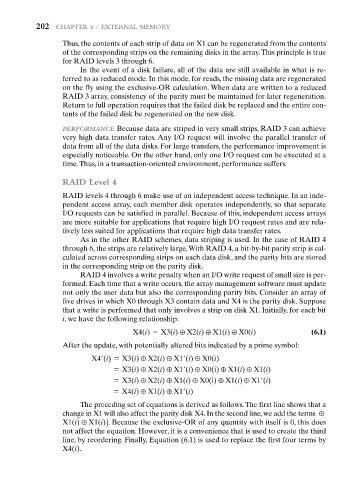
                  five drives in which X0 through X3 contain data and X4 is the parity disk. Suppose
                  that a write is performed that only involves a strip on disk X1. Initially, for each bit
                  i, we have the following relationship:
                                     X4(i) = X3(i) { X2(i) { X1(i) { X0(i)            (6.1)
                  After the update, with potentially altered bits indicated by a prime symbol:

                           X4¿(i) = X3(i) { X2(i) { X1¿(i) { X0(i)
                                 = X3(i) { X2(i) { X1¿(i) { X0(i) { X1(i) { X1(i)
                                 = X3(i) { X2(i) { X1(i) { X0(i) { X1(i) { X1¿(i)
                                 = X4(i) { X1(i) { X1¿(i)

                       The preceding set of equations is derived as follows.The first line shows that a
                  change in X1 will also affect the parity disk X4.In the second line,we add the terms  {
                  X1(i) {  X1(i)]. Because the exclusive-OR of any quantity with itself is 0, this does
                  not affect the equation. However, it is a convenience that is used to create the third
                  line, by reordering. Finally, Equation (6.1) is used to replace the first four terms by
                  X4(i).

