


Page 435 - Corrosion Engineering Principles and Practice
P. 435
404     C h a p t e r   1 0                                                             C o r r o s i o n   i n   S o i l s   a n d   M i c r o b i o l o g i c a l l y   I n f l u e n c e d   C o r r o s i o n    405


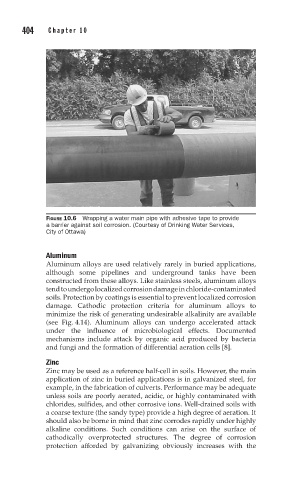
                      FIGURE 10.6  Wrapping a water main pipe with adhesive tape to provide
                      a barrier against soil corrosion. (Courtesy of Drinking Water Services,
                      City of Ottawa)


                      Aluminum
                      Aluminum alloys are used relatively rarely in buried applications,
                      although  some  pipelines  and  underground  tanks  have  been
                      constructed from these alloys. Like stainless steels, aluminum alloys
                      tend to undergo localized corrosion damage in chloride-contaminated
                      soils. Protection by coatings is essential to prevent localized corrosion
                      damage.  Cathodic  protection  criteria  for  aluminum  alloys  to
                      minimize the risk of generating undesirable alkalinity are available
                      (see  Fig. 4.14).  Aluminum  alloys  can  undergo  accelerated  attack
                      under  the  influence  of  microbiological  effects.  Documented
                      mechanisms  include  attack  by  organic  acid  produced  by  bacteria
                      and fungi and the formation of differential aeration cells [8].
                      Zinc
                      Zinc may be used as a reference half-cell in soils. However, the main
                      application of zinc in buried applications is in galvanized steel, for
                      example, in the fabrication of culverts. Performance may be adequate
                      unless soils are poorly aerated, acidic, or highly contaminated with
                      chlorides, sulfides, and other corrosive ions. Well-drained soils with
                      a coarse texture (the sandy type) provide a high degree of aeration. It
                      should also be borne in mind that zinc corrodes rapidly under highly
                      alkaline  conditions.  Such  conditions  can  arise  on  the  surface  of
                      cathodically  overprotected  structures.  The  degree  of  corrosion
                      protection  afforded  by  galvanizing  obviously  increases  with  the

