


Page 431 - Corrosion Engineering Principles and Practice
P. 431
400     C h a p t e r   1 0                                                             C o r r o s i o n   i n   S o i l s   a n d   M i c r o b i o l o g i c a l l y   I n f l u e n c e d   C o r r o s i o n    401


                  Coating type      Advantages             Disadvantages
                  Asphalt/coal tar  Easy to apply          Subject to oxidation
                                    Minimal surface        and cracking
                                    preparation required   Soil stress has been
                                    Long track record in certain   an issue
                                    environments without failure  Limitations at low
                                    Permeable to cathodic   application temperatures
                                    protection in event of failure   Environmental and
                                                           exposure concerns
                                                           Associated with corrosion
                                                           and stress crack corrosion
                                                           failures
                  Tape wrap (two layer)  Simple application  Poor shear stress
                                                           resistance
                                                           Many documented failures
                                                           related to corrosion and
                                                           stress crack corrosion
                                                           Shielding of cathodic
                                                           protection
                                                           Adhesives subject
                                                           to biodegradation
                  Two-layer extruded   Excellent track record  Limited temperature range
                  polyethylene      Good handling          Poor shear stress
                                                           resistance
                                                           Limited pipe sizes
                                                           [< 24 in (60 cm)
                                                           outside diameter]
                  Fusion-bonded epoxy  Excellent adhesion and   Low impact resistance
                                    corrosion resistance   High moisture absorption
                                    Does not shield        and permeation
                                    cathodic protection
                  Three-layer polyotefin  Excellent combination    Best suited for electrical
                                    of properties          resistance welded pipes
                                                           High thickness to eliminate
                                                           weld tenting
                  Composite coating  Excellent combination    Suitable only for large
                                    of properties          diameter pipes and is not
                                    Conforms well to external   designed for small diameter
                                    raised weld profiles   pipes (< 40 cm OD)


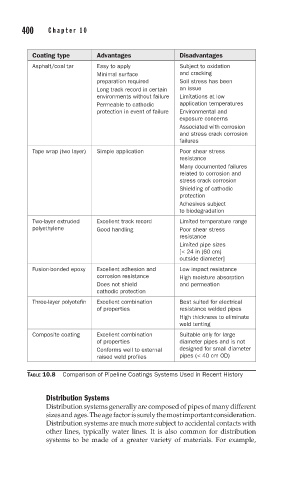
                 TABLE 10.8  Comparison of Pipeline Coatings Systems Used in Recent History

                      Distribution Systems
                      Distribution systems generally are composed of pipes of many different
                      sizes and ages. The age factor is surely the most important consideration.
                      Distribution systems are much more subject to accidental contacts with
                      other  lines,  typically  water  lines.  It  is  also  common  for  distribution
                      systems  to  be  made  of  a  greater  variety  of  materials.  For  example,

