


Page 145 - Courting the Media Contemporary Perspectives on Media and Law
P. 145
136                        Geoffrey Sykes


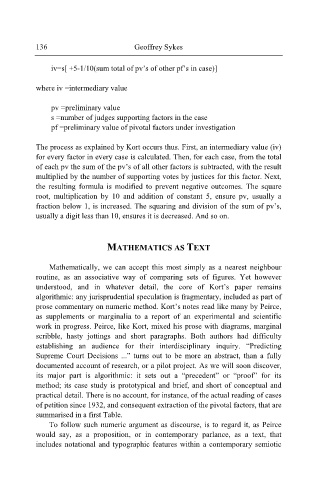
                                  iv=s[ +5-1/10(sum total of pv‘s of other pf‘s in case)]

                             where iv =intermediary value

                                  pv =preliminary value
                                  s =number of judges supporting factors in the case
                                  pf =preliminary value of pivotal factors under investigation

                             The process as explained by Kort occurs thus. First, an intermediary value (iv)
                             for every factor in every case is calculated. Then, for each case, from the total
                             of each pv the sum of the pv‘s of all other factors is subtracted, with the result
                             multiplied by the number of supporting votes by justices for this factor. Next,
                             the  resulting  formula  is  modified  to  prevent  negative  outcomes.  The  square
                             root,  multiplication  by  10  and  addition  of  constant  5,  ensure  pv,  usually  a
                             fraction below 1, is increased. The squaring and division of the sum of pv‘s,
                             usually a digit less than 10, ensures it is decreased. And so on.


                                                MATHEMATICS AS TEXT

                                 Mathematically,  we  can  accept  this  most  simply  as  a  nearest  neighbour
                             routine,  as  an  associative  way  of  comparing  sets  of  figures.  Yet  however
                             understood,  and  in  whatever  detail,  the  core  of  Kort‘s  paper  remains
                             algorithmic: any jurisprudential speculation is fragmentary, included as part of
                             prose commentary on numeric method. Kort‘s notes read like many by Peirce,
                             as  supplements  or  marginalia  to  a  report  of  an  experimental  and  scientific
                             work in progress. Peirce, like Kort, mixed his prose with diagrams, marginal
                             scribble,  hasty  jottings  and  short  paragraphs.  Both  authors  had  difficulty
                             establishing  an  audience  for  their  interdisciplinary  inquiry.  ―Predicting
                             Supreme  Court  Decisions  ...‖  turns  out  to  be  more  an  abstract,  than  a  fully
                             documented account of research, or a pilot project. As we will soon discover,
                             its  major  part  is  algorithmic:  it  sets  out  a  ―precedent‖  or  ―proof‖  for  its
                             method; its case study is prototypical and brief, and short of conceptual and
                             practical detail. There is no account, for instance, of the actual reading of cases
                             of petition since 1932, and consequent extraction of the pivotal factors, that are
                             summarised in a first Table.
                                 To follow such numeric argument as discourse, is to regard it, as Peirce
                             would  say,  as  a  proposition,  or  in  contemporary  parlance,  as  a  text,  that
                             includes notational and typographic features within a contemporary semiotic

