


Page 134 - Crisis Communication Practical PR Strategies
P. 134
1
                                                                            1
                                                                             5
                                        Challenges for the International Food Sector 115
                 carrying 77,000 tons of fuel oil and it had suffered a breakdown
                 and was adrift. The ship’s crew was successfully rescued, but the
                 Spanish authorities discovered a fuel leak at sea.
                   The ship, built in 1976, was leaving a large slick of oil in its
                 wake. The Prestige, sailing under the Bahamas flag, was serving
                 the route Latvia–Singapore and should have been taken out of
                 service long ago. The results of the spill were devastating: 2,000
                 kilometres of coast were polluted by the black tide; fishing was
                 prohibited in a 486 kilometre area and the whole seafood
                 industry faced a serious risk of collapse. It is a good example of
                 an ecological and political catastrophe as well as a food and
                 social crisis.
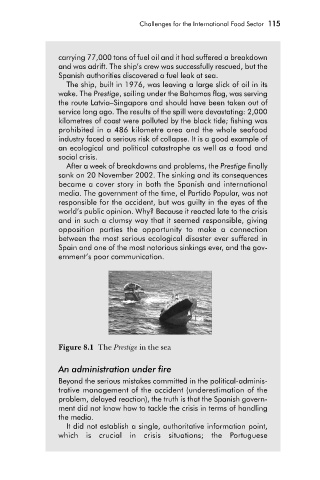
                   After a week of breakdowns and problems, the Prestige finally
                 sank on 20 November 2002. The sinking and its consequences
                 became a cover story in both the Spanish and international
                 media. The government of the time, el Partido Popular, was not
                 responsible for the accident, but was guilty in the eyes of the
                 world’s public opinion. Why? Because it reacted late to the crisis
                 and in such a clumsy way that it seemed responsible, giving
                 opposition parties the opportunity to make a connection
                 between the most serious ecological disaster ever suffered in
                 Spain and one of the most notorious sinkings ever, and the gov-
                 ernment’s poor communication.


                 Figure 8.1 The Prestige in the sea


                 An administration under fire
                 Beyond the serious mistakes committed in the political-adminis-
                 trative management of the accident (underestimation of the
                 problem, delayed reaction), the truth is that the Spanish govern-
                 ment did not know how to tackle the crisis in terms of handling
                 the media.
                   It did not establish a single, authoritative information point,
                 which is crucial in crisis situations; the Portuguese

